Jewish Maghrib Jukebox

Showing posts with label Jo Amar. Show all posts

Friday, May 22, 2015

Mediterranean Musical Trajectories: Judah Sebag and a Rare 78 RPM Recording of Adon Olam


l'Alcazar as it once was
This is a post about the global Mediterranean. It is about Marseille, France serving as a hub of North African music in the era of decolonization. It is about surprising partnerships engendered by the pioneering work of the Armenian-owned record label Disques Tam Tam. Finally, it is about a rare 1950s 78 rpm recording of Judah Sebag performing “Adon Olam,” the liturgical poem chanted weekly in synagogues around the world.

Although many of the details here are obscure, we can begin to trace the trajectory of Judah Sebag. Born in Morocco, Sebag likely made his home in Marseille sometime in the 1950s. There, in the Cours Belsunce quarter, he would have found a space long home to North African cultural production. Indeed, it was here, at l’Alcazar, that Julie Abitbol earned a name for herself some two and half decades prior and became known professionally as Julie Marseillaise (her daughter Widad eventually married the Tunisian artist Hédi Jouini but I’ll save that for another post).


Bobo musicians from Burkina Faso on Tam Tam
In the heart of Cours Belsunce, at 9 Rue Des Dominicains, Sebag would have found the Armenian-owned Disques Tam Tam. So too did other Moroccan Jewish musicians, including but not limited to Abraham El Fassi and Jo Amar. At the Disque Tam Tam studio, Sebag teamed up with a small orchestra consisting of oud, darbouka, and qanoun. Who knows, perhaps the West African and Armenian stars of Tam Tam were milling about when Sebag began to warm up.

Sebag recorded at least two records for Disques Tam Tam but likely a few more. You are about to hear an exceedingly rare 78 rpm recording of Judah Sebag performing that staple of synagogue service, Adon Olam. While Arabic-language North African 78s are difficult to come by, Hebrew-language discs are that much more scarce, so this is a treat. And I have to admit, that Adon Olam, originating sometime in the fifteenth century and meaning “Master of the Universe,” has never quite sounded so good as it has when put to mid-century Moroccan rhythms - despite some surface noise.

I’m not sure what became of Judah Sebag but if any readers out there have any leads, please do send them my way. In the meantime, wishing everyone a Shabbat Shalom.


Thursday, December 18, 2014

Mazal Haï Mazal: Eight North African Tracks to Light Your Soul On Fire

2014 came and went too quickly. I wanted to post more often but as so frequently happens, life got in the way. In lieu of my more regular posts, I offer you, “Mazal Haï Mazal: Eight North African Tracks to Light Your Soul On Fire,” as an end of the year treat. These are eight (one for every night of Hanukkah) of my favorite Moroccan and Algerian tracks (mostly on vinyl but one on cassette) and articulate a range of Maghrebi Jewish sounds - from Andalusian to chaabi to a song about the atomic bomb! Feel free to stream, download, and share.


Consider the title of this end of the year Hanukkah mixtape an Arabic-Hebrew play on words. Indeed for most of the mid-century North African Jewish artists featured here, “mazal” always carried two meanings. In Arabic, mazal meant “still,” as in Lili Labassi’s “Mazal haï mazal” (S/he’s still alive) - a track beautifully presented on the Excavated Shellac blog. But so too did mazal recall the Hebrew for “luck” or “fortune,” a point made by Labassi’s disciple Blond Blond, who sang, “mazal, c’est la chance,” in what is perhaps the only Algerian Hanukkah song ever to be recorded commercially. I say all of this to convey the following: treat my take on Mazal Haï Mazal in both of these senses. Not only is this music “still alive” but so too should we remember that it is through a combination of fortune and luck (and all of our good graces) that it continues to live on.

One last point before we get to the music. Treat this as a soft launch of a crowd funding campaign to turn my private record collection into a public sound archive. On my shelves are historical audio gems that deserved to be shared and I want to make that happen as soon as possible. In other words, keep an eye out on this site in 2015!

Best wishes for the New Year!

Wednesday, April 24, 2013

Sing Out, Maghreb! Jewish Moroccan Protest Music


Maurice Touboul. The Housing Crisis. MT. Early 1960s?

In the course of the recent Arab uprisings, journalists have paid a surprising amount of attention to the role of music in protests. In general, this has been a welcome development, especially when one considers the all but silent soundscape which those writing about the region have reinforced by ignoring it. However, this has also led to the reifying of the notion that protest music in the region is imported. This manifests itself in the focus on style, usually hip hop, over content. Yet, when one digs just a little bit deeper it become eminently clear that at least in the Moroccan case, the likes of rappers Bigg, H-Kayne, and El Haqed (L7a9ed) are taking inspiration from much closer to home, namely the late 1960s and 1970s protest standouts Nass El Ghiwane, Jil Jilala, and Lemchaheb, who themselves drew on indigenous sources.

In fact, protest music in Morocco and in North Africa more generally, is hardly new. The phenomenon goes back to at least the rise of the recording industry in the Maghreb and probably much earlier. Unsurprisingly, Jews played a disproportionate role here as well. The very styles Jews pioneered in early Moroccan, Algerian, and Tunisian music, whether cha’abi or francarabe, can and should be seen as a challenge to the status quo and to the musical powers that were. Jews were derided at the time for such sonic innovation and castigated for corrupting conservative ears. Ultimately, however, these music forms won the day.

Salim Halali. Arja' li bladi. Pathé. 1930s.
In addition to the implicit protest, Jews were considerably explicit as well. In Tunisia, Habiba Messika sang El Ittihad (Unity) in the mid-1920s and Louisa Tounsia sang Ana Arabiya (I'm an Arab) a decade later. In Algeria, Salim Halali sang about his homeland returning to him. Even Zohra El Fassia sang out, championing the cause of Sultan Mohammed V (he was eventually exiled and then returned to the throne by the French) in the late 1940 and 1950s.

As Jews dispersed in the 1950s and 1960s, those who stayed in North Africa past when they were “expected” to, like Algeria’s Alice Fitoussi, challenged nationalist and exclusionary conceptions of citizenship. In many ways, it is these musicians who I am most curious about. What can be said for sure is that wherever North African Jewish musicians went, they and their instruments didn’t remain silent for long. Whenever there was a breach of justice, they took pen to paper and vocalized what was on their minds, thereby giving voice to their compatriots battling difficult or unfamiliar terrain. Their audience enthusiastically joined the chorus.

Jo Amar was one of these musicians. Despite enjoying considerable success in Morocco and internationally, Amar was met with deaf ears by the Ashkenazi music establishment upon aliyah to Israel. To paraphrase the Moroccan-born Azoulay brothers out of Jaffa: Who would sign Jo Amar? We would. Before recording for the mainstream labels, Amar enthusiastically belted out hit after hit for the Azoulay’s Zakiphon imprint. While he sang separately in both Arabic and Hebrew, it was his song Lishkat Avodah (Employment Office) which combined the two and became the darling of the Moroccan community in Israel. I would wager that while many American Jews know Jo Amar well, nearly none have heard this one. In Lishkat Avodah, Amar masterfully calls attention to the suffocating discrimination faced by Moroccans upon their very arrival in Israel. In Arabic, he sings about the separation of children from parents as the former is sent off to the kibbutz in what is a totally alien environment. There is the utter sense of despair coming from the great unknown:

Taken from Haifa to Beit Lid…we were to told to keep going…
We were separated from our parents…
God have mercy on us

Beyond this and the musical dexterity he displays in rhyming the Arabic flous (money) with the Hebrew kibbutz (collective community), he reserves his most blistering verbal attack at minute 3:47 in Hebrew and for all to understand:


I went to the employment office
He asked me where I was from
I told him Morocco
He told me to get out


I went to the employment office
He asked where I was from
I told him Poland
He told me to please to come in


Of course, Amar sang in good company before leaving Israel for the United States. In Israel, his cohort continued to strike a chord regarding passion-stirring issues of the day while his French counterparts frequently intoned on local living conditions. This track by the Moroccan Maurice Touboul is in part the inspiration for this post. It is one of the more curious EPs in my collection and I unfortunately know little about Touboul other than the fact that he was deeply respected by the likes of Samy Elmaghribi and that he was no one hit wonder. In La Crise du Logement, he records at least one Moroccan Jewish attitude to a housing crisis in France and similar to Amar, he calls on God to take note.


Certainly not all Moroccan Jewish protest music can be categorized as "liberal" but all of it took aim at what the community deemed to be unjust, whether the wanton disregard of Maghrebi interests by Israel’s Labor party or the jailing of Aryeh Deri. Nonetheless, these songs continue to resonate.

Some sixty years after Jo Amar first sang Lishkat Avodah, his words remain as powerful as ever. In Kamal Hachkar’s brilliant documentary Tinghir-Jerusalem, the film’s elderly Jewish protagonists recall Amar’s anthem. Fast forward to minute 43:11 and watch, listen, and try not to be moved as their singing of this classic brings Hachkar to tears.

Thursday, April 5, 2012

Singing "Go Down Moses" in Judeo-Arabic - Happy Passover from Jewish North Africa!

Samy Elmaghribi. Le Chant Des Synagogues - "La Haggada". Pathe. 1960s.


The Passover holiday, commemorating the Israelites exodus from slavery to freedom, begins this Friday at Sunset and so when I re-listened to Nathan Cohen's Judeo-Arabic Had Gadya, below, I couldn't resist posting.

From the very beginning of the 20th century, Jewish artists in North Africa recorded liturgy, piyyutim and festival music in a melange of languages (Hebrew, Arabic, Aramaic, etc.) for popular release. The Passover holiday was no different. As many of you know, the festival has always held an important place in the North African Jewish tradition and the unique mimouna celebration marking the end of Passover is a testament to that.

In the 1960s and 1970s, dozens of records were released by musicians from Morocco to Libya on labels ranging from Samyphone (rereleased on Pathe/EMI above), to Dounia (originally owned by a Muslim entrepreneur as I learned from Maurice El Medioni recently and later purchased by El Kahlaoui Tounsi) to the Tunisian label Ennour to the various Zakiphon labels in Israel. These musicians while mastering and pioneering secular, popular Arabic music were also deeply Jewish and recorded religious music, much like their Jewish musical counterparts around the globe.
Nathan Cohen. Moise Sauve Des Eaux. Hagadah De Paque. Ennour. 1970s
With all of that being said, Nathan Cohen, a talented musician originally from Tunisia, has provided Jewish Morocco readers with a real treat. Over his career, Cohen recorded Andalusian, Arabic pop (chaabi) and Jewish music for labels based in France, North Africa and Israel. His unique voice and his penchant for piyyutim made him a stand out in his day.
Nathan Cohen. Haggada De Paque. Le Son Du Chofar (Dounia). 1970s and 1981.
I have digitized Nathan Cohen's Had Gadya for your listening pleasure. Had Gadya, meaning, "one little goat," in Aramic, is a playful, cumulative song that traditionally marks the end of Passover. Drop the song into Google and hundreds of versions will show up but very few if any are in Arabic and fewer less in North African Judeo-Arabic.

The version of Had Gadya below, sung by Nathan Cohen and his choir, is performed in Tunisian Judeo-Arabic. Listen to it a couple times and try not to be hooked.


I had to throw in some Jo Amar as well. Thanks to Phocéephone for the digitization of Jo Amar's Passover LP from the Tam Tam label out of Marseilles. The record starts with Jo going over the Passover seder in French. It's a fun listen despite some of the bumps and hisses. Skip to 11:51 to hear Jo Amar's Aramaic Had Gadya.


More music coming after the holiday including recently unearthed Libyan pop. In the meantime, I wish you and your loved ones a happy, healthy and meaningful Passover!

Sunday, March 11, 2012

The Azoulays, Jewish Libyan Cassettes and Zohra El Fassia's Great Granddaughter

Henry Zehavi performs in Bat Yam - Feb. 2012

The morning after participating in the Bat Yam North Africa sessions, Eilon and I enjoyed a traditional Israeli breakfast of coffee and cigarettes while listening to music. One of the standout pieces he played for me was ostensibly political propaganda and musically-speaking it was dynamite. It was Moroccan Arabic pop music (chaabi) that extolled the virtues of an Ashkenazi mayoral candidate in Ashdod in the 1970s. Using music to convey current events and encourage voting is part and parcel of this genre and in fact much of this political music not only offers insight into these communities and the issues they were concerned with but also an enjoyable listening experience. Judah Assaraf, who sang for a number of Moroccan labels in Israel in the 1960s and 1970s, recorded songs on subjects ranging from the famed peace flight of Iranian-Israeli Abbie Natan (from Israel to Nasser’s Egypt and back again) to the Six Day War to the Herut party.

Between changing records, Eilon showed me some old 78s he had collected that had unfortunately not withstood the test of time but nonetheless shed more light on the musical history discussed on this blog. The 78s in his possession included a number of Jo Amar pieces recorded in Arabic for Philips and a duo known as Abitbol and Fassy that recorded for the N. Sabbah label out of Casablanca.
Joseph Mango Boaron. In Chansone Tripoli. #3. Koliphone. 1970s.
After breakfast, we headed to one of our favorite spots - the Azoulay shop in Jaffa. While Eilon chatted with David and Zaki Azoulay, I picked out some cassettes including a Mike Karoutchi, the Libyan performer Joseph Mango Boaron and a Cheikh Mwijo opus / political call to action to restore the name of Shas leader Aryeh Deri, a former Knesset member convicted of bribery and banned from parliament for ten years in 1999. Each of these cassettes has an interesting story behind it but I’ll save that for another time.

Zakiphon Record Catalogue. Clockwise: Samy Elmaghribi, Albert Suissa, Zohra El Fassia, Jo Amar and Salim Halali.
Our conversation with the Azoulay brothers lasted about an hour but could have lasted for several days as far as I was concerned. In the course of casual conversation, I learned the following:
- Cheikh Zouzou’s son had settled in Israel and brought his father’s recordings with him thereby enabling their rerelease and preservation.
- The Azoulays kept better tabs than I thought and part of the proof of this was the last remaining Zakiphon record catalogue that David showed me and allowed me to photograph.
- AZR, one of the many label names under the Koliphone/Zakiphon suite, stood for Azoulay – Zaki – Raphael.
- Their record factory was based in Holon.
- Their reference points for beauty were still Louisa Tounsia and Line Monty.

With every sentence uttered, my knowledge of the Azoulays, their vision, their personalities and just how mindboggling their operation had been and how much more there is to learn from them increased exponentially.

After fulfilling our Azoulay needs, we headed to Jaffa’s flea market in search of buried vinyl treasure. Over the years, it has become increasingly difficult to find North African records in Jaffa and if they are to be found then they are marked up considerably. However we had a lead and this lead led us to an antique store where the proprietor did in fact have a few EPs remaining. The records were in horrible, horrible condition but I purchased one on the Philix label on the off chance that I would get home, put the needle on the record and be floored. We then had lunch, said our goodbyes and I headed back to Jerusalem.
Eliyahu Kahlaoui (Shlomo Cohen). Bente El Mdina. Philix. Late 1960s?
I returned to the Tel Aviv area a few days later to meet with Karen. Karen is Zohra El Fassia’s great granddaughter who had contacted me through this blog in the hopes of tracking down recordings of her famously talented relative. When I told her I would be in Israel for work, we immediately set up a time to visit and swap stories. The experience was powerful. Karen resembles Zohra and was as warm as I had imagined. As soon as I saw Karen I handed her a CD I had made of digitized Zohra El Fassia 78s. For me, the fact that I was able to share this music with a member of Zohra El Fassia’s family was beyond moving. Karen, in turn, shared with me stories and much more. I learned just how bold Zohra was (she was married multiple times), that her family name was the very common Hammou and how uncommon her life was – more so than I had ever really understood. Karen showed me converted home videos of Zohra El Fassia performing at family gatherings. To paraphrase the poet Erez Bitton, her eyes are full of love in these videos but it’s not only her heart that is clear – so too is her iconic voice in these recordings. I left Karen with a much deeper understanding of just who Zohra El Fassia was and what she stood for. Karen is now working on an online project to capture the history and music of Zohra El Fassia. Let me know if you would like to be in touch with her to contribute photos, music and/or anecdotes.

When I returned to New York days later, I wasn’t disappointed. I dropped the needle on the record and Bente El Mdina practically begged to be digitized. Bente El Medina - City Girl in Arabic – was recorded by Shlomo Cohen aka Eliyahu Kahlaoui for the Philix label, one of the smaller Moroccan labels that cropped up in Israel around the Koliphone/Zakiphon labels. Eliyahu Kahlaoui (Shlomo Cohen) also recorded a song called Bente El Mochav – Moshav Girl in a combination of Arabic and Hebrew - that is the suburban contrast to City Girl. Philix recorded a number of North African musicians in the 1960s and 1970s including Judah Assaraf, who I mentioned above, Brahim Souiri, one of the all time great Moroccan musicians, and the famous Algerian David Elbecheri. Take a listen to Eliyahu Kahlaoui and his troupe below.

Tuesday, January 31, 2012

Jo Amar (El Maghribi) Also Sang in Arabic

Jo Amar. 56120. Zakiphon. 1960s. Side 2 - Mssat Ailaya (Mchate Aaliya by Lili Boniche)
Before I begin a DJ set, I often ask the crowd if they are familiar with any North African Jewish singers and the answer inevitably is, “Yes, the great Jo Amar!” Listeners know his Israeli pop hits like Shir hashikor and Barcelona and his liturgical music like Shalom leben dodi but not much else. Sometimes I will even start off a session playing the album he recorded during his famed 1965 Carnegie Hall performance only to illustrate that this is the music we will not be dealing with in the course of our set. People will say that what set Jo Amar apart was his mastery of various styles including Eastern European melodies but for me that misses the point. Simply put his voice was unparalleled and that is what made him great. He sang almost falsetto. His voice could be soft and lilting at times (which made you listen all the more intently) but in a moment he could switch to a commanding crescendo and just grab you. His voice told a story and this was especially vivid when he sang in Arabic.

What fascinates me is that most are unaware of the fact that Jo Amar recorded 78s in Arabic before moving to Israel and that he continued to not only record Arabic Andalusian music in Israel and elsewhere but also chaabi and Francarabe on LP – Mchate aaliya by Lili Boniche is a perfect example. He wrote his own songs in Arabic and he sang the great songs of others and this post is an attempt to put this history back on the map after being omitted by far too many articles and obituaries.

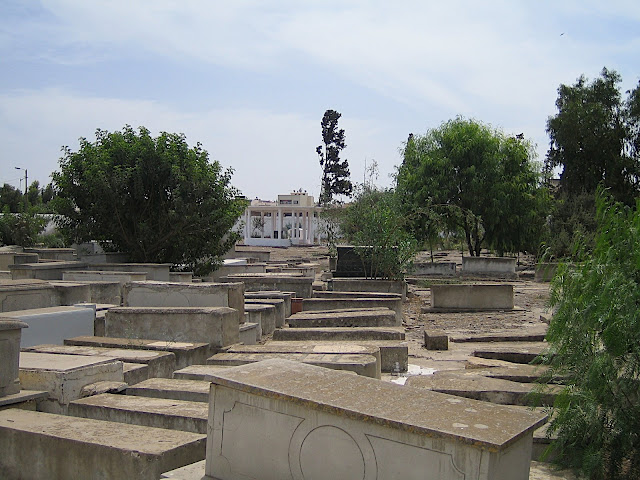
Jewish cemetery in Settat, Morocco (2008)
Jo Amar was born in Settat, Morocco in 1930. By the late 1940s he was recording music in Hebrew and Arabic for Philips. On his Arabic 78s he was known as Jo Amar El Maghribi (Jo Amar the Moroccan) while on his Hebrew 78s he was simply Jo Amar. In 1956 he moved to Israel where he immediately started recording for the Azoulay family – first on 78 on the R. Zaki label and eventually moving to 33 and 45 on Zakiphon.

"Two weeks after I recorded my first song in Israel," recalled Amar in a 2008 interview, "it reached even the most impenetrable Ashkenazi ears." This is one of my all time favorite quotes. You wouldn't expect it from Jo Amar but there he goes again and surprises. By the time Jo Amar arrived in Israel he was a well known entity in the North African community. The Azoulays helped to put him on the musical map in Israel, when no other record label would. The brothers Azoulay apparently sang backup on Shir Hashikor when it was first recorded in Jaffa. Jo Amar would go onto to record for the major Israeli labels as well, on his own Kol Amar label, and on various labels around the world.

Jo Amar El Maghribi. Goulouli fin. Tam Tam. 1960s (Marseilles)

This track is pure Jo Amar. It was recorded in the 1960s for the Tam Tam label out of Marseilles at a time when a number of North African labels were operating there. Goulouli fin is difficult to capture in meaning and in style. It is chaabi-esque as attested to by Tim at Moroccan Tape Stash but it feels like other things are pulling at it. Goulouli fin is Moroccan Arabic for,"Oh tell me where..." There is a sense of longing to the song and it seems to have been paid particular attention to by a number of North African Jewish artists. Below is the cover of a Lili Boniche EP on Dounia where he is performing the same song.

Lili Boniche. Golole fene (Goulouli fin). Dounia. 1960s
Here is a version by my favorite Cheikh Mwijo off of one of his 1980s cassettes. He recorded the song earlier in his career as well.

By 1970 Jo Amar moved to New York – a combination of push and pull factors including the draw of a better career. He eventually became a Cantor and performed in synagogues spanning the Jewish globe. By the late 1980s / early 1990s Amar returned to Israel and throughout the remainder of his life he would finally collect the honors he so deserved. Jo Amar El Maghribi, arguably Settat's most famous singer, died in Woodmere, New York in 2009 at the age of 79.

Articles on Jo Amar:
Jo Amar, Genre-Blending Jewish Singer, Dies at 79 – New York Times – Bruce Webber – July 9, 2009

He opened Israeli ears to Mizrahi songs – Haaretz – Ben Shalev – July 7, 2009 

Jo Amar, acclaimed Sephardic singer, dies – JTA - Ben Harris - June 30, 2009
- Sam Thomas gives an excellent description of what made Jo Amar so unique.

Friday, January 27, 2012

Set List - Jewish Musicians in North Africa at 78 RPM

I had a great session at the JCC last night. Thank you to everyone for coming out. The next session is next Thursday, February 2nd. There was a request for the set list so I have included below. Also, I will be posting a piece on Jo Amar very soon so stay tuned.


Messaoud Habib (Tunisia)
Taksim Ochak
Columbia – Late 1920s?

Cheikh Zouzou (Algeria)
Ghnayet Bensoussan
Philips - 1938

Salim Halali (Algeria)
Bine Elbareh Oua L’youm
Pathe – 1937

Lili L’abassi (Algeria)
Ezhiro
RCA – 1940s

Samy Elmaghribi (Moroccco)
Hobb El Bnet
Pathe – 1948

Zohra El Fassia (Morocco)
Zraa Ouel Matar
Pathe - 1956

Samy Elmaghribi (Morocco)
Allah, Ouatani Oua-Soultani
Samyphone – 1959

Jo Amar (Morocco)
Wine Hbabi Wine Shab
R. Zaki – late 1950s (Israel)

Friday, November 4, 2011

Between Forgetting and Remembering: Charli Elmaghribi and the Other Artists

I recently read a comment on a Youtube video that stirred something inside me. If I recall correctly, the video was of an old recording of the great Moroccan oudist Sliman Elmaghribi. After watching the video I scrolled down to see that one commenter on the video was looking for more information on Sliman. Another commenter said something to the effect of: “It’s sad that barely a generation after many of these artists have passed away…no one remembers them.” In many ways, I feel the same sentiment but in other ways when I look at my own record collection or meet other collectors I realize that not all is lost. Perhaps it just needs to be gathered.

It seems that in every generation North African music is forgotten, rediscovered and recovered to some extent. To get a sense of this historically, I recommend reading Jonathan Glasser’s excellent work on the concept of Andalusian musical patrimony in Algeria in the early 1900s. I have to say that these preservers of this patrimony, whoever it belongs to, often did and continue to do a decent job. There is hoarding to be sure and reluctance to share but thanks to the work of individual ranging from Edmond Nathan Yafil in Algeria to Rafael Azoulay in Israel to Tounsi El Kahlaoui in France, a good deal of North African music is out there somewhere, in some form, waiting to be rediscovered and ripe for new listeners. When I speak about this music publicly, I often ask myself the rhetorical question, “Why does any of this matter?” My first answer - and in many ways the best answer - is that this music is good. It moves the listener. Like that video, it stirs something inside us. For a moment, we share space and time with musicians who gave their heart and soul to this craft and thus it is a part of us.

Charli Elmaghribi (third from left). Le Guerre de Yom Kipour. Koliphone. 1973

I say all this because I want to share some music of a lesser known artist whose work begs to be rediscovered. There are a number of artists who I make frequent mention of on this blog due to how talented they were, how prolific they were and to my dismay how quickly I feel they have been relegated to historical amnesia. But we must remember them because for every Zohra El Fassia there was an Esther Elfassy - also talented, prolific but who likely came of singing age in a different time (the 1970s) and the wrong place (Israel and not Morocco or other parts of the Maghreb) and thus didn’t have the same chances of success. And so for every Jo Amar there was a Sami Amar and for every Samy Elmaghribi there was a Charli Elmaghribi.

Charli Elmaghribi. Koliphone. 1980s.

Charli Elmaghribi recorded for Koliphone/Zakiphon from at least the early 1970s. He is a fantastic oudist and has a distinct voice. He performs everything from Algerian to Moroccan and Andalusian to piyyutim. I want to thank my fellow collector Eilon for pointing out this Youtube video of Charli Elmaghribi in Morocco that seems to date from the late 1980s or early 1990s.


I have digitized the first side of a Charli Elmaghribi cassette from the early 1980s. The little background information I know on Charli is that he is still alive and performing and lives in France. He comes to Israel throughout the year to perform. I wish I could tell you more (his real last name, the city he hails from in Morocco, who his musical influences were) but for now his name and music will have to suffice. I want to stress one more thing.


Charli Elmaghribi - Yamslmin kalbi - Koliphone by CBSilver

 
Charli Elmaghribi - Ya kalbi chali el hal - Koliphone by CBSilver
 
In case of I haven’t made this abundantly clear; much of this music still exists in the Azoulay brother’s shop in Jaffa. I strongly recommend stopping there on your next trip to Israel and purchasing what you can before this music once again becomes lost to time.

Thursday, November 19, 2009

Koliphone/Zakiphon LP Covers


A while back I posted about an article in Haaretz that discussed Zohra El Fassia and the Koliphone/Zakiphon record labels. I was doing a little bit of searching in Hebrew today and came across the Hebrew version of the same article which included the above photo. Check out a very young looking Raymonde (who just performed in Essaouira) all the way to the right. You can also see the album covers of Jo Amar, Sami Elmaghribi (from the Ben Soussan LP - which I recently acquired) and Zohra El Fassia amongst others.

Thursday, July 2, 2009

Jo Amar Passes Away at 79


There have been a few articles about the passing of Jo Amar last week. One of the best I’ve read so far has been the Ben Harris piece at JTA. Simple and well stated - a fitting tribute. Harris describes Amar as a Moroccan singer and Israeli icon and perhaps this is the best description of this man of many worlds. Other articles have aptly described Amar’s contributions to Israeli and Hebrew music and most notably to Mizrahi music but have neglected to mention his contribution to Moroccan and Arabic music. Just as Amar was an Israeli icon, he was also a Moroccan singer. He sang in Hebrew and in Arabic. Upon emigrating to Israel, Amar, like other immigrant singers, recorded music in Arabic at Koliphone (with the Azoulay Brothers) in Jaffa.

Yesterday on my way home from work I stopped by the post office to pick up a package that was waiting for me. I had ordered some old records from Israel and among them was an Arabic language LP entitled Kdam Drssd Ala - sung of course by Jo Amar. Once home I carefully unwrapped the package and removed the record from its sleeve. I placed the record on my turntable and placed the needle on the vinyl and there he was - Jo Amar in all his glory singing in Arabic.