Mea culpa. I’ve been slow on posts this year. To make up for
this absence, I’m going to use Hanukkah as an excuse to shine a light on some
of my favorite North African recordings on Youtube. In the spirit of the
holiday, I’ll be posting once a day for all eight days of Hanukkah. Why am I
turning to Youtube? Well, buried on the video sharing site are some real
musical gems that don’t always get the circulation and attention they deserve
due to either creative orthography or because titles are written in Arabic or
Hebrew. Indeed, each one of these records on Youtube has a story and over the
next week or so I’ll be teasing that out and putting them in their historical
context. I’ll try to keep these posts short and really place a spotlight on the
music.
Perhaps we should start with a question: What did Hatikvah,
the Zionist hymn-turned-official anthem of Israel, sound like in Tunisia circa
1932? Well, thanks to this impossibly rare Gramophone recording from Tunis by a
Mr. Cohen, we know that it was pretty rocking.
You can compare it to this Alma Gluck (soprano) and Efrem Zimbalist (violin) version, recorded in 1918 for Victor, which I imagine many of my readers will be far more familiar with.
Courtesy of Sephardicmusic.org
In the last few years, I have by and large written about
North African Jews who recorded in Arabic but we should not forget that a
plethora of languages were committed to disc in the Maghrib - including Hebrew.
In terms of their Hebrew output, North African Jews not only released
liturgical music on the major labels but so too, comic songs, and as we’ve
already heard, Hatikva (meaning “hope” in Hebrew and also the name of the Zionist anthem). In
addition to Mr. Cohen’s version (which you’ve now hopefully played multiple
times), Babi Bismuth and Messaoud Habib, two of the biggest Tunisian stars of their generation, released their take on the original
1897 nine-stanza poem by Naftali Herz Imber in 1926 for Pathé.
What is remarkable about all of this is just how uncontroversial
the release of Hatikvah in North Africa was at the beginning of the twentieth
century. First, Hatikvah, which obviously pre-dated the founding of Israel and
thus carried different connotations, could be heard in Tunisia for some time. We
even have accounts of mixed Muslim-Jewish orchestras performing it in places
like Sousse as early as 1917. Second, the recording industry across the Maghrib
was used to handling this kind of musical diversity. In the 1932 Gramophone
record catalogue for Algeria and Tunisia, then under the direction of
Mahieddine Bachtarzi, we find the artist Louisa al-Israiliyya (Louisa “the
Jewess,” and listed in later catalogues as Louisa al-Djaziriyya or Louisa
l’Algérienne), who was described as the most “respected maalema” in Algeria,
while Mr. Cohen’s Hatikvah appears on the same page as recordings by the
Soulamia sufi brotherhood of Nabeul and Mohamed Triki’s al-Islamiyya orchestra
(also known as La Musulmane), which had just released their recording of
another anthem - the Beylical hymn.
In far more recent years, there have been calls in Israel to
make the current, shorter version of Hatikvah inclusive of all of the state’s
citizens. One wonders if setting it to the rhythms, instrumentals, and vocal
flairs of Mr. Cohen’s version from Tunisia might be (at least) a step in the right musical
direction.
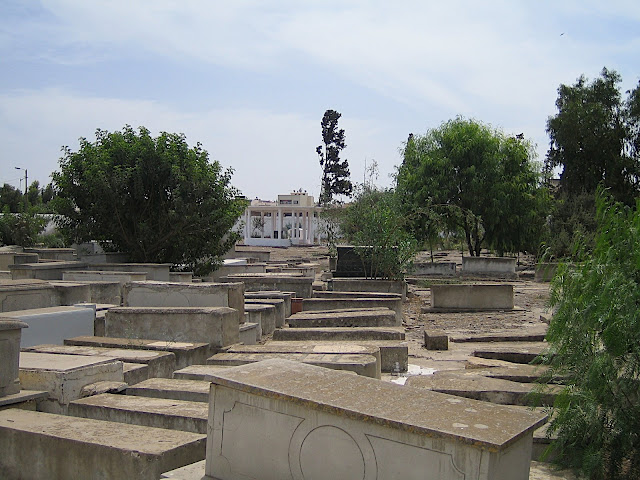
On my final day in post-revolutionary Tunisia, I headed to
the vast Jewish cemetery at Bourgel aiming to find and pay tribute to the final
resting places of Tunis’ musical superstars of years past. While the cemetery
itself is in a discouraging state of disrepair, the tombs of Habiba Messika and
Cheikh El Afrite, two of said vedettes, are readily identifiable, if not
difficult to reach. There is a feeling one gets when visiting a mostly
abandoned Jewish cemetery in North Africa. In seeking a particular grave, you
often have to wade through trash, sidestep discarded beer bottles, whack away
overgrowth, and climb over other broken graves with names no longer legible.
When you reach your destination, it is both unsettling and uplifting and most
certainly a religious experience.
Cassette digging for Habiba Messika
Tunisians’ memory of Habiba
Messika, the young Jewish singer, actress, and diva, who took Tunis by storm in
the 1920s, is at once fierce and fading. Her cassettes, made from copies of
copies of her scare 78 rpm recordings, are easily available in the myriad CD
and tape shops around the city. Ask just about anyone – young or old – and they
“remember” her. This, of course, is despite the fact that most do not actually
remember. While Messika’s brutal murder by a jealous suitor was front-page news
across the Maghreb and in Paris at the time, it also occurred over eighty years
ago, in 1930, and most were not around to ever see her or hear her live at the
Municipal Theatre, at the Casino in La Goulette, or anywhere else. Much like
her music now, the memories of Messika are copies of copies. Of course, this
makes them no less real but as a result certain details have fallen to the
wayside. Thus her Jewishness, very real at the time, comes as shock to quite a
few when revealed. Messika, like so many other things in Tunis, has been
nationalized.
Stack of broken 78s with Narraci sleeve peeking out
Between meetings and visits to the
archives, I went in search of records. On one of my first days in the country,
I was encouraged by a find in the medina: a stack of shellac, all with purple sleeves
of Joseph Narraci, one of the earliest indigenous (and Jewish) record companies
in North Africa. Unfortunately, not a one contained a Narraci-produced record.
In fact, most Tunisian records, especially 78s, have disappeared, many thrown
out in the transition to vinyl, others captive in storage spaces around Tunisia
and in attics in Paris. What stock does exist – in the medina, brocantes, and
the occasional used bookstore - is either Western rock or Egyptian. If you’re
looking for Um Kulthum on Odeon, you’re in luck, if you’re searching for Gaston
Bsiri, bonne chance. While this was personally disappointing, it also served in
a way as a testament to a phenomenon reported on by Tunisian observers of the
78-era – Egyptian discs were flooding the market. Only by supporting local
artists, critics claimed, could this deluge be averted.
After a little less than two weeks
in Tunis (not nearly enough time), I left feeling nostalgic for a place I never
really knew. Strolling down Rue Al-Djazair, adjacent to the medina, brings one
face-to-face with the once flagship record store of Joseph Narraci, as well as
one of the former cinema districts of the silent and then talkie era. Cutting
over to Rue Charles De Gaulle, transports you to the small empire of Bembaron,
Jewish brothers and impresarios, who began their work by importing harmoniums
and ended by creating a powerhouse label which captured the some of the city’s
most impressive voices. The TGM (Tunis-La Goulette-Marsa) train is a journey
back in time. As it traces the edge of the lake, children pry open the doors to
get that fresh, salted wind in their face, only to be pulled back by the scruff
of their necks by a responsible adult – much the same, I imagine, as it was
sixty years ago. Descending at the La Goulette – Casino stop hurls you straight
into Tunis’ music-hall capital, where Jews, Sicilians, Maltese, Greeks, and
Muslims jostled for a seat at one of the various music venues around town. At
the Casino, one might have caught a show by Messika and Hassan Banane, Cheikh
El Afrite or Dalila Taliana. As I dined at one of the seaside restaurants -
with some of the freshest fish I have ever tasted - I daydreamed of Raoul
Journo, perhaps with Kakino De Paz, crooning about exil in El Ouach ouel Ghorba.
Nostalgia is a double-edged sword
though, as it requires absence to make it its most powerful. During my first
day in the archives, a young graduate student took an interest in me and we
began a conversation. She asked me what I worked on and I told her I was studying
the early years of the North African recording industry. She said I must study
the Jewish musicians then if I was really serious about the topic. Encouraged,
I told her that that was indeed my focus and in fact, I was Jewish. She went
blank. You can’t say that here, she said. Not everyone was as open as she was,
she claimed. Similarly, while Bachir Rsaissi’sRsaissi label draws instant
recognition among those in the know, the uttering of his Jewish counterparts –
Narraci and Bembaron - is met with confusion and the polite protest that those
names, in fact, are not Tunisian. Acher Mizrahi, a favorite of Habib Bourghiba
long after independence, also sounds impossibly foreign to some.
El Kahlaoui Tounsi 45 in a dust-filled brocante
Despite all this (or perhaps
because of it), Tunisia has grabbed my attention in a way I never thought it
would. The Tunisians I spent time with were all supportive of my work, even if
it was not their area of expertise. Many went completely out of their way to
help me and I hope by giving a little more volume to the critically important
history of the music industry in North Africa, I can someday soon return the
favor.
Samy Elmaghribi and Salim Halali are still played at the Astor, Fez's last kosher restaurant and bar
Hadj Belaid fresco in Tafraoute (2012)
Some three years after first discovering the magic of
musician Haim Botbol in a record store in Casablanca, I returned to Morocco to
find his music in cassette stalls across the country. In fact, I got an even
deeper sense of the critical importance of music in the Maghreb on this trip.
In Tafraoute, in the country’s deep southwest, frescos of musical instruments
like the rebab and images of musical standouts from the 1940s like Hadj Belaid
adorned walls throughout the region’s ancient villages. At a pizza joint along
the Tizi-n-Tichka pass, a banjo on a chair was displayed prominently. When the
restaurant’s owner wasn’t making pies, he would strum a few chaabi notes. And
in Casablanca, by the former Lincoln Hotel, a cd seller played Samy
Elmaghribi’s version of Gheniet Bensoussan for passersby.
After years of collecting Moroccan and then North African
music in general, I was interested in not only finding dusty recordings from
Tangier to Fez but also to collect musical memories. I was interested in how
Moroccans, Jews and Muslims, understood and remembered their Jewish pop icons
of yesteryear and so I went looking.
I started in Tangier and found very little. I figured a
Mediterranean port city with a once large Jewish community would herald in an
auspicious beginning. Being there during Ramadan hampered my efforts in many
ways. Most medina shops were closed during the day. A general lethargy had set
in. Additionally, Marcel Botbol’s music club, just outside the medina, was
closed and I soon learned he was switching venues but wasn’t due to reopen
until the following month. Undeterred, I kept searching. Walking up and down
medina thoroughfares and side streets, I finally happened on a store selling
clocks that a friend had mentioned. A half dozen sun faded Mohammed Abdel Wahab
LPs were displayed prominently in the window. He must have had more stock, I
thought. He did but he was too tired, he told me. I pressed him but I decided
to let it go. Considering that he had been holding on to records for some
thirty years past their utility and interest for most people, I could
sympathize with his exhaustion. Besides, there would be other opportunities.
The interior of Le Comptoir Marocain de Distribution de Disques (2012)
Where Tangier yielded little, Casablanca was a black gold
mine. I returned to the places which had launched this musical journey for me
three years ago: Le Comptoir Marocain de Distribution de Disques on Lalla
Yacout and Disques Gam in the opposite direction on Boulevard de Paris. At Le
Comptoir, also the home to the Tichkaphone label, I snagged a dozen Botbol
cassettes. It’s safe to say that Le Comptoir represents one end of the record
store spectrum, organized and immaculate, whereas Disques Gam is the other end,
chaotic, hot as hell, and magnificent. Gam Boujemma is the store’s proprietor
and a repository of musical knowledge. You have to know what you’re looking for
here and I did. With every record or cassette he pulled out, I was deluged with
hard to come by oral history. Stories of Samy Elmaghribi performing at the
nearby Cinema Lux fascinated me. As did his reverence for Albert Suissa. I
walked away with a few prize items from his archive including a couple EPs on
the N. Sabbah label and Botbol’s only release for Philips.
Two Giants: Albert Suissa on N. Sabbah and Botbol on Philips (2012)
In Morocco, the musical medium of choice corresponds
directly to the seller’s knowledge of the industry. Those selling records
should be placed at the top of the hierarchy, followed closely by cassette
purveyors and CD distributors a distant third. Also, a couple things happened
in Morocco in the 1970s that should be noted. One, the music industry was
nationalized. Two, cassettes appeared, allowing records to be transferred
directly to tape and distributed widely. The era also represents one of the
last gasps of the prominence of Jews in the Moroccan music scene.
Janatte Haddadi's beautiful short on Coq d'Or
The Casa medina was once a musical mecca for Moroccan Jews.
It was here where Salim Halali’s club Coq d’Or, now a textile factory, once
stood. Albert Suissa continued to live and write music in the mellah until a
late age. So I was elated when I stumbled upon one of the remaining few cassette
sellers in Casa’s medina. His stall was impossibly tiny. Floor to ceiling tapes
lined its walls. With my eyes quickly scanning the now all too familiar
artists, I noticed something peculiar. In his collection were dozens of Israeli
releases of Moroccan Jewish artists from the Holy Land. While the Zakiphon
labels had been removed, these were clearly Jaffa-based releases of Cheikh
Mwijo, Raymonde, and Sliman Elmaghrebi. Here was evidence of a fascinating
chapter of music moving beyond closed borders.
Found: Samy Elmaghribi in a Casa cassette seller's attic(2012)
I told him what I was looking for and he had everything. I
walked away with long sought after Felix El Maghrebi and Zohra El Fassia tapes complete
with hand written song titles. On a whim, I asked if he still had records.
Without flinching he took a rickety ladder and propped it against a wall of
cassettes and started climbing towards his attic. He pulled down two large bags
of 45s. I started to comb through them as my heart raced. What would I find?
The occasional Samy Elmaghribi EP surfaced as did the odd Botbol cover
(including an Algerian release) but unfortunately none of the covers matched
the records and none of what he had was what I was looking for. Despite this, I
had learned a great deal in this encounter.
Hadj Belaid recording on Baidaphon c. 1940s
Before finally heading to Fez, I spent a week with my
girlfriend and friends traveling in the Marrakesh area and to its east. Toward
the end of the week, we visited the village of Telouet, home to a breathtaking
Glaoui casbah. As we left, it started to drizzle and then pour. A nearby café
provided us shelter and piping hot mint tea. On our way in I had noticed a 50s
era HiFi system at the entrance. Where there was a record player, I thought,
there must be records. I started asking the right questions. Within a moment my
hosts informed and then showed me that it still hummed along, in fact, it
played beautifully. They put on a couple of Western LPs and then brought out
two black plastic bags of 78s. These were all priceless 1940s recordings of
Hadj Belaid on Pathé and Baidaphon. We were all having a great time. A waiter
took a lighter to one of the records to show me this was no plastic we were
dealing with. This was shellac! Handshakes were had all around and then I
excused myself to finish my tea.
Le Cristal in Fez, still bustling (2012)
My last few days in Morocco were spent in Fez. For the first
time, I stayed in the Ville Nouvelle. I was captivated. For the tourist and the
historian, some of the beauty of Morocco, even in its “modern” counterpart to
the medina, is the (at least superficially) unchanging landscape and
architecture. Thus my hotel in Fez was located right next to the now defunct
Astor Cinema, which was next to the still in operation Astor Bar (home to Fez’s
remaining kosher restaurant) and a stone’s throw a way from independence era
café’s like the Cristal. You quickly started to get a feel for what Jewish Fez
must have looked like in the 1950s and 60s.
I was not disappointed by what I found in Fez’s medina. After
paying homage to the record-turned-cd label Fassiphone, right outside the old
walls, I launched myself into the city’s infamous myriad alleyways. It was not
before long before that I located the cassette district. One seller’s stash of
Jewish musicians was significantly reduced. About seven tapes were all that
remained. He was eager to sell, including what appeared to be his most
master-like recordings, but I held off.
Botbol, tea, and towers of tapes in Fez (2012)
A twist and a turn later and I had found my man. “Mohammed”
cut a handsome figure against a background of thousands of tapes. He saw me
staring and ushered me “in.” A dozen pleasantries later, short introductions, a
sip of wormwood infused tea, and the cassettes jumped one after one into the
tape deck. Mohammed was a former musician and played often with his Jewish
counterparts. His familiarity with the scene was astonishing. When I asked
about Botbol, Mohammed mentioned he knew Jacob, the father, and then dutifully
put on a recording, which he sang every word to. This pattern of singing along
with the uttering of an artist’s name repeated itself with a range of
performers from Cheikh Mwijo to Samy Elmaghribi. The mere mention of Zohra El
Fassia, the grande dame of Fez, brought a large smile to his face. He started
recalling the heyday of places like the Astor and Cristal and others. I
couldn’t resist, I bought way too much from him but it was worth it. He then
took us to his gorgeous medina home for another cup of tea. His roof view
rivaled any in the city. I asked him to see pictures but instead I got his
address with a request to keep in touch. I couldn’t have been happier to
oblige. Mohammed wasn’t sure if anyone still sold records in Fez but
I was happy nonetheless. Not everything has been transferred to CD so getting
your hands on tapes is the next best thing.
Prized records including Botbol, bottom row (left) (2012)
Zohra El Fassia on Polyphon c. 1940s (2012)
I took the long way out of the
medina and I’m glad I did. A few missteps and backtracks later and I had
located what may be Fez’s last record store. The owner, much older than
Mohammed, was also a former musician. Hundreds of records were arranged in some
of the most creative ways I had ever seen. He displayed his most prized
records, including a not-for-sale Botbol, on one side of the store. At his desk
were beautiful black-and-white and sepia photos of his former life. Behind him
were cassettes of Morocco’s most influential stars including Samy Elmaghribi,
whom the proprietor called the best Isra’ili singer in Moroccan history. I
painstakingly combed through piles of LPs and EPs and pulled out impossibly
difficult to find cuts. As I continued to look high and low for records, which
seemed to be hiding everywhere, I saw a dozen 78s in the corner. I gently
removed them from the shelf. Sifting through these treasures one by one, my
heart skipped a beat. There it was…a 70-year-old recording of Cheikha Zohra El
Fassia made for the Polyphon label. I showed it to the owner. He put on his
glasses and said zeena (beautiful). Sadly, the record itself was beyond playing
condition but its near forgotten presence in this store still sings volumes to
me.
By the late 1970s and possibly even earlier, Morocco’s King Hassan II was listening to Raymonde El Bidaouia on vinyl. So enthralled with her records, he invited her to perform at the Royal Palace in Rabat in 1981. Raymonde was to perform together with the late, great Samy Elmaghribi. She and Samy knew each other well thanks to the Azoulay brothers. She wasn’t what Samy expected at first but she and her voice soon grew on him. He was certainly the legend but Raymonde was the rising star and soon they began touring the world together.
Raymonde's 12th LP for the Koliphone label
On the night she was set to sing with Samy in front the King, Raymonde considered cancelling. She was understandably nervous. She had never performed before royalty. To add insult to injury, she felt like a fraud. She had always borrowed lyrics from Samy, Albert Suissa, and other greats. The songs that she did write revolved around drinking and partying. Hardly regal (maybe). And yet, she knew she had to go on. She went on stage and approached the mic. Within moments, the tiny blonde with the outsized vocals blew everyone away. What was supposed to be a warm up turned into a full-blown concert lasting until 1 in the morning and only then did Samy take the stage.
Raymonde dons a traditional-ish djelaba for an album cover
Raymonde Abecassis was born in 1943 in Casablanca and moved with her family to Israel in 1952. Like other Moroccan immigrants, life wasn’t easy for Raymonde and her family. She worked hard and married early. It was only after the birth of her daughter, the Israeli actress Yael Abecassis, that she launched her music career. She set herself apart quickly. She rejected trappings like gold jewelry and traditional dress (unless it was for an album cover or special performance) and instead opted for her signature blonde hair, t-shirt, and jeans. By the 1970s, she was recording hit record after hit record for the Koliphone and Zakiphon labels out of Jaffa. She became known as Raymonde El Bidaouia (Raymonde the Casablancan) in Israel, Morocco, and beyond. Some went as far as to call her Cheikha Raymonde. In Israel, she collaborated with Meyer Elbedawi, Judah Assaraf, Eliyahu Kahlaoui (who has been featured on this blog before), and non-Moroccans like the Egyptian violinist Felix Mizrahi.
By the 1990s, after decades of making music, Raymonde launched her television and film career. Today, she continues to act and has since launched a Moroccan Arabic theater project in Israel.
What I love about Raymonde is her voice and her swagger. Raymonde has chutzpah in the best way possible and she laughs in the face of shouma. When a reporter once asked Raymonde why she sings in Arabic and not in Hebrew, she said, “Could I be like Chava Alberstein? No, I am Raymonde.” You can feel all of this drive in her music.
Raymonde. Tomobil. Koliphone. 1970s
Below is one of my favorite Raymonde songs. It’s titled Tomobil, which means car in Moroccan Arabic. This song is about a number of different things – there’s a meta component at the beginning where her and her partner discuss (argue about) driving to the studio to make a record (taklit in Hebrew), there’s the piece where she’s looking to buy a car but doesn’t know how to drive but above all this the song is self-indulgent, celebratory, and one that only Raymonde could pull off. It’s a record you put on at a hafla or in a smoky bar and turn up the volume. Also, not sure if anyone else hears this but the dialogue at the beginning of this track is vaguely reminiscent of the dialogue at the beginning of Lili L’abassi’s original Wahran El Bahia.
Rumor has it that Raymonde is set to tour again in Israel soon. Take a listen to this so that you can sing along in person next time you see her in concert.
So since it’s summer and because it’s blazing hot, I’m adding two additional tracks to this post – both on the subject of drinking (alcohol has been a favorite subject for Moroccan singers – Jewish and Muslim alike – since at least the advent of recorded music).
I suggest you open a Flag beer or take a sip of mahia and listen to Atiuli El Kass by Raymonde. Pay particular attention as Raymonde gives a shout out to the kass (cup) of whiskey. Thanks to Toukadime for uploading this a little while back.
And this is mostly for my Arabic speaking listeners, but check out this routine from Raymonde and the comedian Maurice Lusky. It’s the intro to her song Skran (the drunkard in Moroccan Arabic). For those who don’t speak Arabic, this is still an excellent introduction to Moroccan comedy and the music at the very end of the sketch is beyond great. I would love to see a full translation of this bit if anyone is feeling ambitious.
Finally, I’ll be blogging from France and Morocco this summer. Stay tuned for more updates.
Get your rare North African music fix the night before Passover! I will be spinning and discussing music in North Africa and North African music in Israel as part of Proteus Gowanus' series on migration. This session comes on the heels of a recent trip to Israel that netted some long lost Libyan music and more.
Samy Elmaghribi and his boys perform in Morocco
Proteus Gowanus 543 Union Street
Brooklyn, NY 11215 718.243.1572
Thursday, April 5, 8 pm $5 admission
Music, Migration and the Maghreb
By the beginning of the 20th century, the phonograph had become a fixture in bars, cafes and theaters across North Africa. With an eye toward a new market, the major international record labels soon moved in and recorded the greatest Jewish and Muslim musicians of their generation. The labels captured sounds that would come not only to define Arabic music in the region but also to preserve a fascinating history of Jewish-Muslim musical collaboration in the Maghreb.
By mid-century, North Africa and the music scene changed dramatically.
In the immediate aftermath of Israel’s establishment and Moroccan, Algerian and Tunisian independence, thousands of Jews from across the region made the Jewish state their new home including many of these musicians. Israel held little promise of a continued career for these artists and almost no hope of continued collaboration until a pioneering Moroccan immigrant found a cache of phonographs in a Jaffa flea market, started recording those around him and preserved this shared patrimony while enabling new styles to emerge. Join us to hear the story as we spin rare records from North Africa and Israel.
Spending a few days in Tel Aviv and Jerusalem and just found a great stash of North African records in the Jaffa flea market. Looking forward to cleaning up when I get home and digitizing. In the meantime, enjoy a couple photos.
The morning after participating in the Bat Yam North Africa sessions, Eilon and I enjoyed a traditional Israeli breakfast of coffee and cigarettes while listening to music. One of the standout pieces he played for me was ostensibly political propaganda and musically-speaking it was dynamite. It was Moroccan Arabic pop music (chaabi) that extolled the virtues of an Ashkenazi mayoral candidate in Ashdod in the 1970s. Using music to convey current events and encourage voting is part and parcel of this genre and in fact much of this political music not only offers insight into these communities and the issues they were concerned with but also an enjoyable listening experience. Judah Assaraf, who sang for a number of Moroccan labels in Israel in the 1960s and 1970s, recorded songs on subjects ranging from the famed peace flight of Iranian-Israeli Abbie Natan (from Israel to Nasser’s Egypt and back again) to the Six Day War to the Herut party.
Between changing records, Eilon showed me some old 78s he had collected that had unfortunately not withstood the test of time but nonetheless shed more light on the musical history discussed on this blog. The 78s in his possession included a number of Jo Amar pieces recorded in Arabic for Philips and a duo known as Abitbol and Fassy that recorded for the N. Sabbah label out of Casablanca.
Joseph Mango Boaron. In Chansone Tripoli. #3. Koliphone. 1970s.
After breakfast, we headed to one of our favorite spots - the Azoulay shop in Jaffa. While Eilon chatted with David and Zaki Azoulay, I picked out some cassettes including a Mike Karoutchi, the Libyan performer Joseph Mango Boaron and a Cheikh Mwijo opus / political call to action to restore the name of Shas leader Aryeh Deri, a former Knesset member convicted of bribery and banned from parliament for ten years in 1999. Each of these cassettes has an interesting story behind it but I’ll save that for another time.
Zakiphon Record Catalogue. Clockwise: Samy Elmaghribi, Albert Suissa, Zohra El Fassia, Jo Amar and Salim Halali.
Our conversation with the Azoulay brothers lasted about an hour but could have lasted for several days as far as I was concerned. In the course of casual conversation, I learned the following:
- Cheikh Zouzou’s son had settled in Israel and brought his father’s recordings with him thereby enabling their rerelease and preservation.
- The Azoulays kept better tabs than I thought and part of the proof of this was the last remaining Zakiphon record catalogue that David showed me and allowed me to photograph.
- AZR, one of the many label names under the Koliphone/Zakiphon suite, stood for Azoulay – Zaki – Raphael.
- Their record factory was based in Holon.
- Their reference points for beauty were still Louisa Tounsia and Line Monty.
With every sentence uttered, my knowledge of the Azoulays, their vision, their personalities and just how mindboggling their operation had been and how much more there is to learn from them increased exponentially.
After fulfilling our Azoulay needs, we headed to Jaffa’s flea market in search of buried vinyl treasure. Over the years, it has become increasingly difficult to find North African records in Jaffa and if they are to be found then they are marked up considerably. However we had a lead and this lead led us to an antique store where the proprietor did in fact have a few EPs remaining. The records were in horrible, horrible condition but I purchased one on the Philix label on the off chance that I would get home, put the needle on the record and be floored. We then had lunch, said our goodbyes and I headed back to Jerusalem.
Eliyahu Kahlaoui (Shlomo Cohen). Bente El Mdina. Philix. Late 1960s?
I returned to the Tel Aviv area a few days later to meet with Karen. Karen is Zohra El Fassia’s great granddaughter who had contacted me through this blog in the hopes of tracking down recordings of her famously talented relative. When I told her I would be in Israel for work, we immediately set up a time to visit and swap stories. The experience was powerful. Karen resembles Zohra and was as warm as I had imagined. As soon as I saw Karen I handed her a CD I had made of digitized Zohra El Fassia 78s. For me, the fact that I was able to share this music with a member of Zohra El Fassia’s family was beyond moving. Karen, in turn, shared with me stories and much more. I learned just how bold Zohra was (she was married multiple times), that her family name was the very common Hammou and how uncommon her life was – more so than I had ever really understood. Karen showed me converted home videos of Zohra El Fassia performing at family gatherings. To paraphrase the poet Erez Bitton, her eyes are full of love in these videos but it’s not only her heart that is clear – so too is her iconic voice in these recordings. I left Karen with a much deeper understanding of just who Zohra El Fassia was and what she stood for. Karen is now working on an online project to capture the history and music of Zohra El Fassia. Let me know if you would like to be in touch with her to contribute photos, music and/or anecdotes.
When I returned to New York days later, I wasn’t disappointed. I dropped the needle on the record and Bente El Mdina practically begged to be digitized. Bente El Medina - City Girl in Arabic – was recorded by Shlomo Cohen aka Eliyahu Kahlaoui for the Philix label, one of the smaller Moroccan labels that cropped up in Israel around the Koliphone/Zakiphon labels. Eliyahu Kahlaoui (Shlomo Cohen) also recorded a song called Bente El Mochav – Moshav Girl in a combination of Arabic and Hebrew - that is the suburban contrast to City Girl. Philix recorded a number of North African musicians in the 1960s and 1970s including Judah Assaraf, who I mentioned above, Brahim Souiri, one of the all time great Moroccan musicians, and the famous Algerian David Elbecheri. Take a listen to Eliyahu Kahlaoui and his troupe below.
Jo Amar. 56120. Zakiphon. 1960s. Side 2 - Mssat Ailaya (Mchate Aaliya by Lili Boniche)
Before I begin a DJ set, I often ask the crowd if they are familiar with any North African Jewish singers and the answer inevitably is, “Yes, the great Jo Amar!” Listeners know his Israeli pop hits like Shir hashikor and Barcelona and his liturgical music like Shalom leben dodi but not much else. Sometimes I will even start off a session playing the album he recorded during his famed 1965 Carnegie Hall performance only to illustrate that this is the music we will not be dealing with in the course of our set. People will say that what set Jo Amar apart was his mastery of various styles including Eastern European melodies but for me that misses the point. Simply put his voice was unparalleled and that is what made him great. He sang almost falsetto. His voice could be soft and lilting at times (which made you listen all the more intently) but in a moment he could switch to a commanding crescendo and just grab you. His voice told a story and this was especially vivid when he sang in Arabic.
What fascinates me is that most are unaware of the fact that Jo Amar recorded 78s in Arabic before moving to Israel and that he continued to not only record Arabic Andalusian music in Israel and elsewhere but also chaabi and Francarabe on LP – Mchate aaliya by Lili Boniche is a perfect example. He wrote his own songs in Arabic and he sang the great songs of others and this post is an attempt to put this history back on the map after being omitted by far too many articles and obituaries.
Jewish cemetery in Settat, Morocco (2008)
Jo Amar was born in Settat, Morocco in 1930. By the late 1940s he was recording music in Hebrew and Arabic for Philips. On his Arabic 78s he was known as Jo Amar El Maghribi (Jo Amar the Moroccan) while on his Hebrew 78s he was simply Jo Amar. In 1956 he moved to Israel where he immediately started recording for the Azoulay family – first on 78 on the R. Zaki label and eventually moving to 33 and 45 on Zakiphon.
"Two weeks after I recorded my first song in Israel," recalled Amar in a 2008 interview, "it reached even the most impenetrable Ashkenazi ears." This is one of my all time favorite quotes. You wouldn't expect it from Jo Amar but there he goes again and surprises. By the time Jo Amar arrived in Israel he was a well known entity in the North African community. The Azoulays helped to put him on the musical map in Israel, when no other record label would. The brothers Azoulay apparently sang backup on Shir Hashikor when it was first recorded in Jaffa. Jo Amar would go onto to record for the major Israeli labels as well, on his own Kol Amar label, and on various labels around the world.
Jo Amar El Maghribi. Goulouli fin. Tam Tam. 1960s (Marseilles)
This track is pure Jo Amar. It was recorded in the 1960s for the Tam Tam label out of Marseilles at a time when a number of North African labels were operating there. Goulouli fin is difficult to capture in meaning and in style. It is chaabi-esque as attested to by Tim at Moroccan Tape Stash but it feels like other things are pulling at it. Goulouli fin is Moroccan Arabic for,"Oh tell me where..." There is a sense of longing to the song and it seems to have been paid particular attention to by a number of North African Jewish artists. Below is the cover of a Lili Boniche EP on Dounia where he is performing the same song.
Here is a version by my favorite Cheikh Mwijo off of one of his 1980s cassettes. He recorded the song earlier in his career as well.
By 1970 Jo Amar moved to New York – a combination of push and pull factors including the draw of a better career. He eventually became a Cantor and performed in synagogues spanning the Jewish globe. By the late 1980s / early 1990s Amar returned to Israel and throughout the remainder of his life he would finally collect the honors he so deserved. Jo Amar El Maghribi, arguably Settat's most famous singer, died in Woodmere, New York in 2009 at the age of 79.
From time to time I have small groups over at my apartment for listening sessions. These listening sessions allow me to share old recordings and the overall listening experience in an intimate setting while also providing me with a laboratory to demonstrate certain themes or try out new ideas. At a recent session, I decided to play some pieces that reflected the theme of “God, Country, King,” the official motto of Morocco. What I love about this theme is that it allows me to showcase some unexpected music from some well known artists including Esther Elfassy, Albert Suissa and Samy Elmaghribi. At first I thought that for readers / listeners familiar with Moroccan music and the role that Moroccan Jews played in the music industry that perhaps these tracks wouldn't be so unexpected but on second thought I'm not so sure. Even if the themes are expected - nationalist, religious - the singers, timing and styles aren't. A young Esther Elfassy singing about the oneness of God in haunting Arabic in Israel in the 1970s or Samy Elmaghribi singing a marche Marocaine shortly before his departure from Morocco - especially when contrasted with his other music.
Nonetheless this music is very different from what I have posted previously. Below I've including some biographical information on these three great singers and some of their dynamite tracks. As you'll see, there is some biographical information missing, especially with Esther and Albert. I would love for readers to help me fill in these gaps.
Esther Elfassy
Esther Elfassy performing in Paris
Esther Elfassybegan recording for the Azoulay brothers under the Koliphone and Zakiphon labels in Israel in the early 1970s. She mostly recorded songs written by Moshe Ben Hamo but did also write some of her own work. She sang chaabi and incorporated some Hebrew in her music from time to time. What I love about her in many ways is her Arabic (of course in addition to her killer voice). She reminds us of course that Moroccan Jews have historically expressed even Jewish religious concepts in Arabic. One of my favorite tracks of hers is called Zoro El Kotel (Visiting the Western Wall in a combination of Maghrebi Arabic and Hebrew).
Esther Elfassy. Zakiphon. 1970s
The track below is religious / devotional in nature. It is a song about the oneness of God and the repetitiveness is rhythmic. Judging from some of her other work and her picture, it's not what one would expect from her but that's what I love about it.
Albert Suissa performing at a Bar Mitzvah celebration in Morocco. 1950s
Albert Suissa was a giant of Moroccan music. He recorded dozens of records (including many 78s) for a half dozen labels including N. Sabbah, Casaphone, Boussiphone, Koliphone and Zakiphon. He was a killer singer and oudist.
Albert Suissa. Koliphone. 1960s
Below is a song called Hasan Tani Ala Slamtic Sidna. Suissa uses the honorific "sidna" for King Hassan II, a Moroccan title used for royalty and the exaltation of saintly figures. The song pulls you in from the very beginning. The song in many ways is about power and protection and conveys both those feelings from the start through pounding singing and instrumentals. Check it out below.
Advertisement for Samyphone records. Le Voix des Communautés (Rabat, published 1950-1963). March 1, 1963, pg. 3.
I'm not going to give his entire bio here but needless to Samy Elmaghribi was one of the all time great Moroccan musicians. At the height of his popularity there wasn't a person in Morocco who didn't know his name or who hadn't heard heard his music. Even to this day, mention the name Samy Elmaghribi in Morocco and elsewhere and you will get a big smile.
Samy Elmaghribi (center with oud) signing records after a performance
Born Solomon Amzalleg in the coastal city of Safi in 1922, he was already a singing sensation by the 1940s and throughout the course of his early career he recorded dozens of 78 records for Pathe. In 1955-56, he established his own record label Samyphone and by 1959 he had moved to France. He sang in a variety of styles including in the various Moroccan and Algerian Andalusian traditions, his own sometimes scandalously secular work and classic popular tunes. By 1962 the Azoulay family began exclusively distributing Samy Elmaghribi's recordings under the Koliphone and Zakiphon labels. The Azoulays were also the first to bring Samy to Israel to perform and managed his career there. In 1967 he settled in Montreal, served as the cantor at the Spanish and Portuguese Synagogue and continued to perform around the world. In 1987 he moved to Ashdod, Israel where he lived until 1996 when he returned to Montreal. He died on Mary 9, 2008 at the age of 86.
The track below is one side of one of his rare Samyphone 78s and his 8th release on his label. It is an upbeat anthem that invokes the Moroccan motto of God, Country, King. He sounds young here but nonetheless is clearly in command of his band known affectionately as "Samy's boys." Here he sings in praise of all things nationalist Moroccan - the Moroccan military, King Mohammed V, King Hassan II and of course the people. Listen to it a couple of times - it's much different than anything you've heard him sing.
Felix el Maghrebi was a mainstay of the Moroccan pop scene in the 1960s. His real name was Felix Weizman - Weizman being a somewhat popular Moroccan Jewish last name not related to its Ashkenazi counterpart. He died on March 6, 2008, right before the death of Samy ElMaghribi
I've been listening to a number of his 45s recently which I have only found on the N. Sabbah label, an indigenous Moroccan label produced in Casablanca. Interestingly, I have only seen / heard N. Sabbah 78s and 45s but no 33s. It seems as though N. Sabbah recorded mostly Jewish artists although as you will see from the back of this Felix el Maghrebi EP, the label also produced Muslim artists.
Felix el Maghrebi. El Frak & Khel Laiounne. N. Sabbah. 196?
Felix el Maghrebi. El Frak & Khel Laiounne. N. Sabbah. 196?
Felix el Maghrebi. Kaftanec Mahlou & El Mlaine. N. Sabbah. 196?
The first record is in my possession but I grabbed the second record image from the Jewish Moroccan Heritage site based in Belgium. If you click here, you can see a bunch of Moroccan Jewish 45 album covers. The Botbol cassette I recently uploaded can be seen in its record form as well as an Albert Suissa EP on Casaphone. I wish there were a way to bring these to the forefront of the site a bit more but a little searching does the trick.
I'll be uploading some more album art soon but in the meantime enjoy.
Haaretz ran an excellent piece the other day that highlighted some of what I discussed with the Jo Amar entry - namely that Moroccan musicians continued to record (in Arabic) upon arrival in Israel.
Here are a couple interesting notes from the article:
Israeli musicians "discovering" Moroccan music
Some of the Moroccan music produced in Israel has been lost forever (due to a fire in the 1980s that destroyed the master copies of this music)
The article also discusses the the later years of her life. Here is some more background on Zohra El Fassia (also known as Cheikha Zohra El Fassia due to her mastery of a number of popular genres and traditional styles including gharnati, aita and melhoun).
A link to her "Ya Warda" can be found here. For a video of her performing, click here.
On a personal note, I have been working to collect the old LPs of Zohra El Fassia and other Moroccan Jewish artists including Sami El Maghribi, Cheikh Mwijo and others. As the above article discusses, this music is quickly being lost and we need to preserve it.
Here are a couple of excellent compilation CDs that feature (prominently) North African Jews: