Jewish Maghrib Jukebox

Showing posts with label Koliphone. Show all posts

Monday, July 9, 2012

Raymonde El Bidaouia: The Blonde Bombshell from Casablanca


A young Raymonde
By the late 1970s and possibly even earlier, Morocco’s King Hassan II was listening to Raymonde El Bidaouia on vinyl. So enthralled with her records, he invited her to perform at the Royal Palace in Rabat in 1981. Raymonde was to perform together with the late, great Samy Elmaghribi. She and Samy knew each other well thanks to the Azoulay brothers. She wasn’t what Samy expected at first but she and her voice soon grew on him. He was certainly the legend but Raymonde was the rising star and soon they began touring the world together.

Raymonde's 12th LP for the Koliphone label
On the night she was set to sing with Samy in front the King, Raymonde considered cancelling. She was understandably nervous. She had never performed before royalty. To add insult to injury, she felt like a fraud. She had always borrowed lyrics from Samy, Albert Suissa, and other greats. The songs that she did write revolved around drinking and partying. Hardly regal (maybe). And yet, she knew she had to go on. She went on stage and approached the mic. Within moments, the tiny blonde with the outsized vocals blew everyone away. What was supposed to be a warm up turned into a full-blown concert lasting until 1 in the morning and only then did Samy take the stage.

Raymonde dons a traditional-ish djelaba for an album cover
Raymonde Abecassis was born in 1943 in Casablanca and moved with her family to Israel in 1952. Like other Moroccan immigrants, life wasn’t easy for Raymonde and her family. She worked hard and married early. It was only after the birth of her daughter, the Israeli actress Yael Abecassis, that she launched her music career. She set herself apart quickly. She rejected trappings like gold jewelry and traditional dress (unless it was for an album cover or special performance) and instead opted for her signature blonde hair, t-shirt, and jeans. By the 1970s, she was recording hit record after hit record for the Koliphone and Zakiphon labels out of Jaffa. She became known as Raymonde El Bidaouia (Raymonde the Casablancan) in Israel, Morocco, and beyond. Some went as far as to call her Cheikha Raymonde. In Israel, she collaborated with Meyer Elbedawi, Judah Assaraf, Eliyahu Kahlaoui (who has been featured on this blog before), and non-Moroccans like the Egyptian violinist Felix Mizrahi.

By the 1990s, after decades of making music, Raymonde launched her television and film career. Today, she continues to act and has since launched a Moroccan Arabic theater project in Israel.

What I love about Raymonde is her voice and her swagger. Raymonde has chutzpah in the best way possible and she laughs in the face of shouma. When a reporter once asked Raymonde why she sings in Arabic and not in Hebrew, she said, “Could I be like Chava Alberstein? No, I am Raymonde.” You can feel all of this drive in her music.

Raymonde. Tomobil. Koliphone. 1970s
Below is one of my favorite Raymonde songs. It’s titled Tomobil, which means car in Moroccan Arabic. This song is about a number of different things – there’s a meta component at the beginning where her and her partner discuss (argue about) driving to the studio to make a record (taklit in Hebrew), there’s the piece where she’s looking to buy a car but doesn’t know how to drive but above all this the song is self-indulgent, celebratory, and one that only Raymonde could pull off. It’s a record you put on at a hafla or in a smoky bar and turn up the volume. Also, not sure if anyone else hears this but the dialogue at the beginning of this track is vaguely reminiscent of the dialogue at the beginning of Lili L’abassi’s original Wahran El Bahia.

Rumor has it that Raymonde is set to tour again in Israel soon. Take a listen to this so that you can sing along in person next time you see her in concert.


So since it’s summer and because it’s blazing hot, I’m adding two additional tracks to this post – both on the subject of drinking (alcohol has been a favorite subject for Moroccan singers – Jewish and Muslim alike – since at least the advent of recorded music).

I suggest you open a Flag beer or take a sip of mahia and listen to Atiuli El Kass by Raymonde. Pay particular attention as Raymonde gives a shout out to the kass (cup) of whiskey. Thanks to Toukadime for uploading this a little while back.


And this is mostly for my Arabic speaking listeners, but check out this routine from Raymonde and the comedian Maurice Lusky. It’s the intro to her song Skran (the drunkard in Moroccan Arabic). For those who don’t speak Arabic, this is still an excellent introduction to Moroccan comedy and the music at the very end of the sketch is beyond great. I would love to see a full translation of this bit if anyone is feeling ambitious.


Finally, I’ll be blogging from France and Morocco this summer. Stay tuned for more updates.

Wednesday, May 23, 2012

Show this Saturday at JCC + Cheikh Mwijo, Lili L'abassi & Shimon Bar Yohai

Come listen to Cheikh Mwijo and others this Sat., May 26th at JCC Manhattan
I'll be spinning rare North African records this Saturday night, May 26th for a set called Sheikh it, Baby! Arabic Music, Jewish Musicians. The set is part of the wonderful Tikkun Leil Shavuot program at the JCC Manhattan. I go on at 12.30 am (technically May 27th) in the 4th floor studio. I'm adding some recent killer finds to the playlist, so bring a friend and come check it out. The full schedule of events can be found here.

Judeo-Arabic song verse in praise of Rabbi Shimon Bar Yohai
Composed by Albert Suissa and printed in Casablanca (1950s)
Tikkun Leil Shavuot in its current form is a modern twist on an ancient tradition. Shavuot marks the anniversary of the Israelites receiving the Torah from God. One tradition relates that the Israelites prayed and studied for three days and nights in anticipation of receiving the Torah and so, we emulate this all-night regiment to remember and recreate this sacred study session.

Shavuot (meaning weeks in Hebrew) comes seven weeks after Passover. If you've been following the news or my Twitter feed (www.twitter.com/jewishmorocco) lately, you may have noticed an uptick in Jewish pilgrimages (hilloulot in Hebrew) over the last couple weeks in Morocco and Tunisia. These pilgrimages to Rabbi's tombs usually fall on or right around Lag B'Omer, a holiday that occurs 33 days after Passover and which marks the anniversary of the death of Rabbi Shimon Bar Yohai, a 2nd century Rabbi and disciple of the famed Rabbi Akiva. According to lore, Lag B'Omer is also the date that Rabbi Shimon Bar Yohai revealed the Zohar, the foundational text of Kabbalah.

Now the tie-in for all of this is something I've written about before and that is the fascinating convergence of the sacred and secular in North African Jewish music. For example, the melody for Samy Elmaghribi's scandalously secular Kaftanek Mahloul (Blond Blond performs it here) was quickly incorporated into liturgical poetry for the synagogue in 1950s Morocco and beyond (Binyamin Bouzaglo performs El Hay Ram Gadol to the tune of Kaftanek Mahloul here).

I recently discovered another track that made the transition from secular to sacred. Lili L’abassi was born Elie Moyal in Sidi Bel Abbas, Algeria in or around 1909. By his early 20s, he was already being referred to as Cheikh for his mastery of the violin and Arabic song. His popularity rose steadily in the 1930s and 1940s and he can be thought of as the Jewish Hadj Mohammed El Anka in terms of popularizing chaabi music. One of his most popular songs is Wahran El Bahia (Oran the Brilliant/Shining/Beautiful) and is an ode to the city that has produced some of Algeria's greatest musicians, past and present. Wahran El Bahia has become the unofficial anthem of Oran and continues to be sung to this day.

Below is a clip of the song being performed by El Gusto, a Jewish and Muslim orchestra originally formed in Algeria in the 1950s and recently reunited. The musicians of El Gusto, now in their 70s through 90s, had lost touch post-Algerian independence and were brought together over the last few years thanks to the efforts of the filmmaker Safinez Bousbia, who captured this story in her compelling documentary. Make sure you see this film El Gusto, if you haven't already.

Pay close attention to the very animated violinist and singer in this El Gusto concert recording because it is none other than Robert Castel, son of the great Lili L'abassi. To the right, you can also make out Luc (or Lili) Cherki. Play the song in its entirety once or twice, so you get a real feel for the melody.

Check out this 1970s recording by Cheikh Mwijo in Israel. It's called Meron El Bahiya and is a pretty amazing piece about Rabbi Shimon Bar Yohai. Mt. Meron (in Israel) is the pilgrimage site for the Lag B'Omer holiday and the burial place of Rabbi Shimon Bar Yohai. Lag B'Omer and Rabbi Shimon Bar Yohai have long been popular song topics for Jewish North African recording artists. One of my most interesting 78s, for example, is a 1950s recording of a Lag B'Omer hilloula in Tlemcen, Algeria. Now take a close listen to the Cheikh Mwijo song below. This is the same melody and refrain as Lili L'abassi's Wahran El Bahiya but with Meron swapped for Oran! The sacred has again adopted the secular.


While you're pondering all of this, I'm going to give another shoutout to my twitter feed and mention that you can like this blog on Facebook (www.facebook.com/jewishmorocco). I'll be posting some exciting news soon...so keep an eye out.

Friday, March 30, 2012

Digging for North African Records in Israel

Spending a few days in Tel Aviv and Jerusalem and just found a great stash of North African records in the Jaffa flea market. Looking forward to cleaning up when I get home and digitizing. In the meantime, enjoy a couple photos.

Tuesday, January 31, 2012

Jo Amar (El Maghribi) Also Sang in Arabic

Jo Amar. 56120. Zakiphon. 1960s. Side 2 - Mssat Ailaya (Mchate Aaliya by Lili Boniche)
Before I begin a DJ set, I often ask the crowd if they are familiar with any North African Jewish singers and the answer inevitably is, “Yes, the great Jo Amar!” Listeners know his Israeli pop hits like Shir hashikor and Barcelona and his liturgical music like Shalom leben dodi but not much else. Sometimes I will even start off a session playing the album he recorded during his famed 1965 Carnegie Hall performance only to illustrate that this is the music we will not be dealing with in the course of our set. People will say that what set Jo Amar apart was his mastery of various styles including Eastern European melodies but for me that misses the point. Simply put his voice was unparalleled and that is what made him great. He sang almost falsetto. His voice could be soft and lilting at times (which made you listen all the more intently) but in a moment he could switch to a commanding crescendo and just grab you. His voice told a story and this was especially vivid when he sang in Arabic.

What fascinates me is that most are unaware of the fact that Jo Amar recorded 78s in Arabic before moving to Israel and that he continued to not only record Arabic Andalusian music in Israel and elsewhere but also chaabi and Francarabe on LP – Mchate aaliya by Lili Boniche is a perfect example. He wrote his own songs in Arabic and he sang the great songs of others and this post is an attempt to put this history back on the map after being omitted by far too many articles and obituaries.

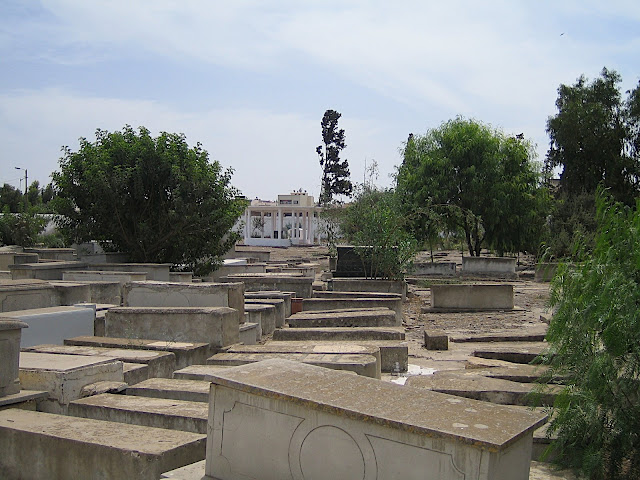
Jewish cemetery in Settat, Morocco (2008)
Jo Amar was born in Settat, Morocco in 1930. By the late 1940s he was recording music in Hebrew and Arabic for Philips. On his Arabic 78s he was known as Jo Amar El Maghribi (Jo Amar the Moroccan) while on his Hebrew 78s he was simply Jo Amar. In 1956 he moved to Israel where he immediately started recording for the Azoulay family – first on 78 on the R. Zaki label and eventually moving to 33 and 45 on Zakiphon.

"Two weeks after I recorded my first song in Israel," recalled Amar in a 2008 interview, "it reached even the most impenetrable Ashkenazi ears." This is one of my all time favorite quotes. You wouldn't expect it from Jo Amar but there he goes again and surprises. By the time Jo Amar arrived in Israel he was a well known entity in the North African community. The Azoulays helped to put him on the musical map in Israel, when no other record label would. The brothers Azoulay apparently sang backup on Shir Hashikor when it was first recorded in Jaffa. Jo Amar would go onto to record for the major Israeli labels as well, on his own Kol Amar label, and on various labels around the world.

Jo Amar El Maghribi. Goulouli fin. Tam Tam. 1960s (Marseilles)

This track is pure Jo Amar. It was recorded in the 1960s for the Tam Tam label out of Marseilles at a time when a number of North African labels were operating there. Goulouli fin is difficult to capture in meaning and in style. It is chaabi-esque as attested to by Tim at Moroccan Tape Stash but it feels like other things are pulling at it. Goulouli fin is Moroccan Arabic for,"Oh tell me where..." There is a sense of longing to the song and it seems to have been paid particular attention to by a number of North African Jewish artists. Below is the cover of a Lili Boniche EP on Dounia where he is performing the same song.

Lili Boniche. Golole fene (Goulouli fin). Dounia. 1960s
Here is a version by my favorite Cheikh Mwijo off of one of his 1980s cassettes. He recorded the song earlier in his career as well.

By 1970 Jo Amar moved to New York – a combination of push and pull factors including the draw of a better career. He eventually became a Cantor and performed in synagogues spanning the Jewish globe. By the late 1980s / early 1990s Amar returned to Israel and throughout the remainder of his life he would finally collect the honors he so deserved. Jo Amar El Maghribi, arguably Settat's most famous singer, died in Woodmere, New York in 2009 at the age of 79.

Articles on Jo Amar:
Jo Amar, Genre-Blending Jewish Singer, Dies at 79 – New York Times – Bruce Webber – July 9, 2009

He opened Israeli ears to Mizrahi songs – Haaretz – Ben Shalev – July 7, 2009 

Jo Amar, acclaimed Sephardic singer, dies – JTA - Ben Harris - June 30, 2009
- Sam Thomas gives an excellent description of what made Jo Amar so unique.

Friday, November 4, 2011

Between Forgetting and Remembering: Charli Elmaghribi and the Other Artists

I recently read a comment on a Youtube video that stirred something inside me. If I recall correctly, the video was of an old recording of the great Moroccan oudist Sliman Elmaghribi. After watching the video I scrolled down to see that one commenter on the video was looking for more information on Sliman. Another commenter said something to the effect of: “It’s sad that barely a generation after many of these artists have passed away…no one remembers them.” In many ways, I feel the same sentiment but in other ways when I look at my own record collection or meet other collectors I realize that not all is lost. Perhaps it just needs to be gathered.

It seems that in every generation North African music is forgotten, rediscovered and recovered to some extent. To get a sense of this historically, I recommend reading Jonathan Glasser’s excellent work on the concept of Andalusian musical patrimony in Algeria in the early 1900s. I have to say that these preservers of this patrimony, whoever it belongs to, often did and continue to do a decent job. There is hoarding to be sure and reluctance to share but thanks to the work of individual ranging from Edmond Nathan Yafil in Algeria to Rafael Azoulay in Israel to Tounsi El Kahlaoui in France, a good deal of North African music is out there somewhere, in some form, waiting to be rediscovered and ripe for new listeners. When I speak about this music publicly, I often ask myself the rhetorical question, “Why does any of this matter?” My first answer - and in many ways the best answer - is that this music is good. It moves the listener. Like that video, it stirs something inside us. For a moment, we share space and time with musicians who gave their heart and soul to this craft and thus it is a part of us.

Charli Elmaghribi (third from left). Le Guerre de Yom Kipour. Koliphone. 1973

I say all this because I want to share some music of a lesser known artist whose work begs to be rediscovered. There are a number of artists who I make frequent mention of on this blog due to how talented they were, how prolific they were and to my dismay how quickly I feel they have been relegated to historical amnesia. But we must remember them because for every Zohra El Fassia there was an Esther Elfassy - also talented, prolific but who likely came of singing age in a different time (the 1970s) and the wrong place (Israel and not Morocco or other parts of the Maghreb) and thus didn’t have the same chances of success. And so for every Jo Amar there was a Sami Amar and for every Samy Elmaghribi there was a Charli Elmaghribi.

Charli Elmaghribi. Koliphone. 1980s.

Charli Elmaghribi recorded for Koliphone/Zakiphon from at least the early 1970s. He is a fantastic oudist and has a distinct voice. He performs everything from Algerian to Moroccan and Andalusian to piyyutim. I want to thank my fellow collector Eilon for pointing out this Youtube video of Charli Elmaghribi in Morocco that seems to date from the late 1980s or early 1990s.


I have digitized the first side of a Charli Elmaghribi cassette from the early 1980s. The little background information I know on Charli is that he is still alive and performing and lives in France. He comes to Israel throughout the year to perform. I wish I could tell you more (his real last name, the city he hails from in Morocco, who his musical influences were) but for now his name and music will have to suffice. I want to stress one more thing.


Charli Elmaghribi - Yamslmin kalbi - Koliphone by CBSilver

 
Charli Elmaghribi - Ya kalbi chali el hal - Koliphone by CBSilver
 
In case of I haven’t made this abundantly clear; much of this music still exists in the Azoulay brother’s shop in Jaffa. I strongly recommend stopping there on your next trip to Israel and purchasing what you can before this music once again becomes lost to time.

Tuesday, August 2, 2011

Death of Rabbi Elazar Abuhatzeira, Memories of Tafilalt and Cheikh Mwijo

The new Jewish cemetery in Rissani (2008)

The tragic news of the murder of Rabbi Elazar Abuhatzeira, grandson of the Baba Sali, in Be'er Sheva, Israel last Friday, July 29 brought back memories of my travels in Tafilalt where in a way this story really begins. Tafilalt is the area of southern Morocco that borders the Sahara where the Abuhatzeira dynasty originally hails from. The area includes the shrine of Rabbi Shmuel Abuhatzeira, cousin of the Baba Sali, in Erfoud, the remnants of the historic Jewish communities of Ghirlane and other villages and of course the original home of the Baba Sali in Rissani. I'm going to write more about Erfoud, Ghirlane and Rissani in an upcoming post but first I want to start with the figure of the Baba Sali and some music that will help situate this story.

As you will recall from a post I put up in January, Cheikh Mwijo, the legendary singer from Meknes, and the Abuhatzeira family have long had a history. At the time I recounted the following, "First, it should be noted that Mwijo has a number of songs that exalt Moroccan tzaddiqim. One of these songs is a tribute to Rabbi Yaakov Abu Hasira, the grandfather of the Baba Sali, who died on a pilgrimage to the Land of Israel and was buried in the Nile Delta in Egypt. Abu Hasira’s tomb became a site of pilgrimage and has recently attracted media attention due to local Egyptian opposition to the annual influx of Israelis and Jews. When the Baba Sali caught wind of this song and of Cheikh Mwijo he invited Mwijo to visit him in Netivot in the Negev. Mwijo couldn’t make the journey from Kiryat Ata right away but eventually would come to pay his respects. The Baba Sali couldn’t understand how Mwijo knew so much about his grandfather. Mwijo revealed to the Baba Sali that he was a Meknesi at which point the Baba Sali exclaimed that everything now made sense as Meknes was a city of great torah scholars. To honor Mwijo, Baba Sali asked Mwijo to drink arak from the same cup as Rabbi Y. Abu Hasira, his grandfather (it was unclear whether the cup was used by his grandfather or if the arak had actually been partially consumed by his grandfather). Mwijo drank dutifully but was forced to hold his nose while doing so for he hated arak. As Mwijo told this story animatedly, I remembered the arak I had left in the car and thought that somehow the Baba Sali must have been watching over me."

I have digitized Cheikh Mwijo's Rabb Abouhassira off of his 14th LP. It dates from the 1970s. It is fascinating ode to the Baba Sali and his grandfather and recounts, in Judeo-Arabic, the history of the Abuhatzeira family and the Jews of the Sahara.

Cheikh Mwijo. Rabb Abouhassira. #14. Koliphone. 1970s
Take a listen.

Rabb Abouhassira - Cheikh Mwijo (Koliphone, 1970s) by CBSilver

Thursday, May 26, 2011

Moroccan Jewish Music at JCC Manhattan - June 7, 2011

Zohra El Fassia. Laarosa. Zakiphon. 196?

Come check out my sessions at JCC Manhattan

Here is the schedule:

12:30 am
Koliphone Records: The Untold Story of Israel’s Arabic Singing Jewish Musicians

1:45 am
Sheikh it Baby: Arabic Music by Jewish Musicians

I know it's technically June 8 but come on the 7th and stay through the 8th :)

Thursday, January 20, 2011

Cheikh Mwijo # 23 Digitized - Classic Recordings

More Cheikh Mwijo - this time on cassette. The quality isn't perfect but I'm on a tape kick right now. I'm fairly positive that the album cover was shot in Mwijo's current home - I recognize the red vinyl.

Cheikh Mwijo. #23. Ze lo halom. Koliphone/Zakiphone

Cheikh Mwijo. #23. Goulouli fine. Koliphone/Zakiphone


Cheikh Mwijo. #23. Gzali houwa sbabi. Koliphone/Zakiphone

Cheikh Mwijo. #23. Lbnat. Koliphone/Zakiphone

Meeting the Legendary Cheikh Mwijo

Cheikh Mwijo. #12. Koliphone/Zakiphone. 1970s

When you google Koliphone, the Israeli record label started by the Azoulay brothers in Jaffa in 1953 that pioneered and produced Arabic music sung by Jews from North Africa and the Middle East, a couple of things come up. One is my blog and other is the work of Uri Wertheim in Israel. Knowing I would be in Israel in December, I sent Uri a fairly benign Facebook message about record digging for North African LPs in Haifa and Jerusalem. Our conversation quickly moved beyond finding records and soon involved tracking down and interviewing the remaining Arabic singing musicians from the 1960s.

In December, we met in person for the first time. I was greeted by Uri and his dog Fred in the Florentine section of Tel Aviv not too far from the Central bus station. We headed to Hummus Abu George for lunch. We ordered two bowls of hummus with ful. We spoke about Koliphone records, the Azoulay brothers, how Uri got into collecting (he started working for one of the Azoulay brothers earlier in his career), record digging and everything in between. On our way out we ran into the other members of his band The Apples.

We headed to Uri’s apartment with Fred. Uri’s record collection really blew me away. Outside of the Azoulay brothers themselves, I would venture to say that Uri has the most complete collection of Koliphone records in the world. My personal interest in Koliphone stems from my interest in Moroccan Jewish music and North Africa in general but Uri has done an excellent job focusing on this label and the various associated labels (Zakiphon, Pianophon, etc.) and building a collection. Amongst other things, Uri had 45s that I had never seen before – for instance, before I arrived in Israel I knew of two Zakiphon 45s entitled Alass Ya Nasser (Why O Nasser) songs in Moroccan Judeo-Arabic on Israel’s 1967 victory - but Uri had a whole series of these EPs. He also had a nice collection of Albert Suissa, Cheikh Elafrite (Tunisian), Geoula Barda (Libyan), Raoul Journo (Tunisian) and anything else you can imagine – it was really unbelievable. We listened to some records including some 78s on an old portable phonograph that we weren’t sure was going to work (it did). We then listened to some Cheikh Mwijo.

Cheikh Mwijo. #7. Koliphone/Zakiphone. 1970s

Somehow in the course of our messages and emailing before I arrived in Israel, Cheikh Mwijo had come up. Cheikh Mwijo, (real name: Moshe Attias), had long occupied my imagination. Of all the Moroccan Jewish performers he was one of the most recognizable and perhaps the most flamboyant. The album artwork on his records was unmistakably him. There is the one where he gazes admiringly at a record, the one where he wears a fur coat and holds a cigarette in one hand and a violin in the other, another where there are four different images of Mwijo – one in traditional Moroccan garb, one wearing a yarmulke and studying text, one in a suit and one by a video camera. Above all else, Mwijo’s voice is distinct and that is what makes him stand out. Before arriving in Israel we (mostly Uri) worked on tracking down Mwijo so that we could interview him and record him. Most of the musicians of Mwijo’s era have passed – many in recent years (Samy Elmaghribi, Jo Amar, etc.) and that was part of the reason why this was so important.

Back of Cheikh Mwijo #7. Album Covers. Koliphone/Zakiphone. 1960 - 70s

We called Cheikh Mwijo from a landline. The phone was on speaker. It was a tremendous feeling to hear the voice that I only knew from 60s and 70s LPs. Mwijo told us he welcomed our visit, we hung up the phone and Uri and I got to planning.

I met Uri and Uri’s brother Noam at the car rental agency, stopping by a liquor store on the way to buy a nice bottle of arak for Cheikh Mwijo. We left Tel Aviv by late morning and headed toward Kiryat Ata, Cheikh Mwijo’s adopted city. The journey took a couple of hours with a stop for lunch. We made our way north through areas recently devastated by fire.

We pulled into Kiryat Ata and began to look for Mwijo’s home address. As we slowly crept up his street I spotted Mwijo sitting at a café wearing his signature tarbush. He looked like he had always looked. My heart raced. We were originally supposed to meet him at his house but there he was sitting in the café by his apartment smoking a cigarette. This was a future album cover. We parked the car and tried not to overwhelm him with our enthusiasm. He knew we wanted to meet him but he wasn’t sure what the point was. Moroccans the world over already knew Mwijo, he told us. We told him that not everyone knew his story and that this was an important endeavor we were embarking on. We showed him my blog (the whole thing was very meta) and the recently posted clip from Haim Abitbol. He wasn’t impressed. Mwijo had performed with Marcel Abitbol. He told us to follow him to his home.

Mwijo looked sharp – slacks, dress shirt and tarbush. He was much shorter than I ever imagined. Ani ben adam pashut, he kept saying in Hebrew. I am a simple man. It was true. He lived very simply. His home was small and exhibited touches of Morocco (a Moroccan style couch for example). He had a single picture on his living room wall and it hinted at a once great musical career - a framed, color copied image of Mwijo in front of the Eiffel Tower with his name spelled Cheikh Moizo (there are a number of ways his name has been spelled throughout his career) and superimposed above his head. We sat not in the living room but in the dining room. Images of Rabbi Ovadia Yosef, the Baba Sali and Moroccan tzaddiqim adorned the walls. We sat around the dining room table. His chair was a white plastic chair with a leather car seat attached to it for comfort.

The room filled with cigarette smoke quickly. We asked some questions when we could but mostly he spoke. Mwijo was born Moshe Attias in Meknes in 1937. He came from a family of musicians. His father, Yaakov Attias, a musician, died young at the age of 32. Yaakov Attias was originally from Fez and married Mwijo’s mother in Meknes. Mwijo spent some time growing up in the Fez mellah on Rue du Mellah, the main drag. When I asked him where exactly, he asked me in Arabic if I was Arab or Jewish and how I knew about Morocco. He then recalled an incident in the 1940s (he would have been very young) where a Vichy officer recorded his family’s name – anti-Semitism was something that would come up periodically throughout our conversation with Mwijo and this incident, in particular, stuck with him. Mwijo’s grandfather had also been a musician. Mwijo has a number of brothers who are still alive and who he still performs with. He then showed us an unbelievable black and white photo (below):

In the picture (left to right): Sliman Elmaghribi, Sliman’s father Mordechai, Muallem David Ben Haroush, Mimoun Turjeman, Yaakov Zerad and Mwijo’s father Yaakov Attias.

Mwijo first learned music by listening to this band of Jewish musicians. In Israel, Muallem (an honorific title like cheikh) David Ben Haroush would soon become Mwijo’s main influence.

Mwijo moved to Israel in Israel in 1962 at the age 35. His profession, which if I understood correctly, was an embroiderer of military uniforms and was not needed in Israel (with their scaled back, simple military uniforms and their ranks made of medal) and he showed us the 1962 letter from the Security Services Office to prove it. He touched on his experiences in the ma’abarot, the transit camps for Jews from North Africa and the Middle East, and on what he described as racism towards Moroccans in Israel then and now.

Muallem Ben Haroush would eventually also settle in Israel, in Kiryat Haim, where Mwijo would support him during his final days. As a gift to Mwijo, Ben Haroush left him his songbooks, which had also been handed to down to him. The songbooks would prove to be the source from which Mwijo drew his strength. I can’t stress enough what these songbooks represent. It is incomprehensible what is tied up in these songs – the heritage of Moroccan music, Moroccan Jewish history -- history that can be found nowhere else but buried somewhere in Mwijo’s modest apartment. Apparently, when Professor Joseph Chetrit of Haifa University became aware of the books he asked Mwijo if he could photograph them for his research. Mwijo refused. He thought Chetrit was just out to make money (clearly not the case and not the case with books published by academic presses) and that Mwijo wasn’t going to get his cut. So for now, only one man has studied and mastered those songs since Ben Haroush and that man is Mwijo. It is because he committed the songs in the books to memory – a dramatic turnaround from his earlier years when he could only ever remember parts of songs – that Mwijo maintains the honorific title of Cheikh – the master of 1,000 songs. In a final odd musical twist, we learned from Mwijo that Muallem David Ben Haroush is buried in Haifa near Mike Brant, the 1970s Israeli pop star who committed suicide at the height of his career.

At this point in Mwijo’s life, a number of things happened in tandem. Mwijo discovered that his profession was no longer needed in Israel and that he had been given two gifts – the songbooks and a voice. Sitting in a café in Haifa one day, Mwijo began to sing and this, he recalled, literally brought unsuspecting patrons to tears. All of these factors – a lack of employment, a mastery of songs and a unique voice helped launch Cheikh Mwijo’s career in the music industry.

Mwijo began his music career singing and playing the mandolin but he would eventually switch to the violin, played in the upright North African style (he would later deride Western style violin playing for not being sufficiently difficult). He never learned to read music. Between 1962 and 1970, Mwijo estimates he wrote and sold about 40 songs to Sliman Elmaghribi, the young musician pictured at the far left of the black and white photo he had showed us earlier.

By 1969, Mwijo had started his own recording career. Zaki Azoulay, one third of the Azoulay trio, came to Mwijo in his home with reel-to-reel tape and recorded him live. It sold very well. Later Mwijo would record dozens of records and cassettes for the Azoulay brothers and their Koliphone/Zakiphon label at their studio on Raziel Street in Jaffa, across the street from where the current Azoulay brothers’ store now stands. The recording sessions were all “live to tape” sessions but today, he told us, he prefers multi-track recording.

In the course of conversation he shared with us a few stories that correspond roughly to the height of his career. At this point I’m not entirely sure how to describe these stories. They are demonstrative of a number of things – Mwijo’s religious zeal, his relationship to other Moroccans and Jews, how Mwijo sees himself in history, his feelings on the Holocaust and anti-Semitism – or perhaps they are just anecdotes that are interesting.

First, it should be noted that Mwijo has a number of songs that exalt Moroccan tzaddiqim. One of these songs is a tribute to Rabbi Yaakov Abu Hasira, the grandfather of the Baba Sali, who died on a pilgrimage to the Land of Israel and was buried in the Nile Delta in Egypt. Abu Hasira’s tomb became a site of pilgrimage and has recently attracted media attention due to local Egyptian opposition to the annual influx of Israelis and Jews. When the Baba Sali caught wind of this song and of Cheikh Mwijo he invited Mwijo to visit him in Netivot in the Negev. Mwijo couldn’t make the journey from Kiryat Ata right away but eventually would come to pay his respects. The Baba Sali couldn’t understand how Mwijo knew so much about his grandfather. Mwijo revealed to the Baba Sali that he was a Meknesi at which point the Baba Sali exclaimed that everything now made sense as Meknes was a city of great torah scholars. To honor Mwijo, Baba Sali asked Mwijo to drink arak from the same cup as Rabbi Y. Abu Hasira, his grandfather (it was unclear whether the cup was used by his grandfather or if the arak had actually been partially consumed by his grandfather). Mwijo drank dutifully but was forced to hold his nose while doing so for he hated arak. As Mwijo told this story animatedly, I remembered the arak I had left in the car and thought that somehow the Baba Sali must have been watching over me.

In the 1970s, Mwijo often performed abroad and frequently in France. One time, while in France, a Moroccan (unclear whether this Moroccan was Jewish or Muslim) invited him to perform in Germany. Mwijo adamantly refused to play in Germany because of the Holocaust – even after an offer of 10,00 Deutschmarks from his host which he explained was a lot of money at the time. He was impassioned when telling us this story. His voice rose and sank as he progressed. After the refusal, Mwijo immediately headed to a casino, pulled the handle on a slot machine and won the equivalent of 10,000 Deutschmarks. This was divine intervention, he argued and said rhetorically that if this wasn’t a sign (from God) then nothing was.

Mwijo then transitioned to telling us more about his career in Israel. Mwijo never received any royalties for his music instead he began by earning 10 Israeli lira per song (he would share some of this with Sliman when they performed together) and payment for each record produced. It is unclear what exactly his relationship is today to Zaki Azoulay as a result of their financial arrangements although I would guess based on what I understood from Mwijo and the nature of producer-artist relationships that it is strained at best.

Mwijo feels that he is unique among Moroccan performers. He does not like the style of Salim Halali or a number of other artists. In fact, he prefers Algerian (djiri) music to Moroccan (chaabi) and describes his singing style as djiziri, which he says is more delicate and sweet than other North African styles. To that effect, he says he performed with the Algerian National Orchestra in France in 1981, which to me underscored his complex relationship with North Africa. He has returned to Morocco once and only to perform at a Jewish celebration.

In the course of our time with him he shared with us other fascinating anecdotes. He seems to have been present at all the major life cycle events of Aryeh Deri, the former head of Shas, including his brit milah in Meknes. Mwijo’s connection to Deri, whether ideological or otherwise, is incredibly potent. In fact, Mwijo penned him a song in 2000 as Deri headed to prison on a bribery conviction.

Chris Silver. Cheikh Mwijo. Uri Wertheim. Noam Wertheim - 2010

There was a point when it became clear that it was time for us to leave. We took a picture with Mwijo and exchanged pleasantries. Uri asked Mwijo if he could visit him again. In 10 years – Mwijo said. He had grown tired and preferred to look forward rather than back. For nearly 50 years Cheikh Mwijo has made good Moroccan music. As we exited the apartment, he told us to check him out in March when he would perform at the Dead Sea.

Monday, July 12, 2010

Samy Elmaghribi - New York


When I was last in Israel, I visited a number of record stores and made a number of contacts who had Moroccan, Algerian, Tunisian and Libyan vinyl that they were willing to part with. I'm listening right now to some Samy Elmaghribi. The first title on this Koliphone/Zakiphon produced album is called New York. On New York, Samy sings about the boroughs and ends that line with talking about how the boroughs are well known (m3roofeen). He then lists the boroughs and ends with Brooklyn (Brookleen) to make a great rhyme and then sings about people in New York coming from many different religions (kul deen) to complete it. Great song. Great album. Very upbeat. If anyone has a full translation of New York, please let me know.

Friday, May 21, 2010

Azoulay Bros - Jaffa, Israel

Have been off the internet for a while and thus haven't posted. Will be back on the internet come this Thursday. In the meantime, I've posted some videos below. Pretty amazing.

I recently went to Israel with work. I took some personal time after the trip and went to Jaffa to the Azoulay Bros. shop to talk to them about Koliphone and of course to do some shopping. A few months ago I spoke about a fire that tore through their recording studio in the late 80s that destroyed most (if not all) of their master copies of some of the great North African Jewish musicians. They have no Koliphone or Zakiphon records for sale although they do hang some 7's around the store (see videos below).


They are working on recovering records but these records are now sold for too much money to really buy back in large quantities. They do sell some great CDs though for those interested (Cheikh Mwijo, Raymonde, Sami Elmaghribi, Line Monty, etc.).


I ended up buying some Zakiphon produced tapes (Cheikh Mwijo, Maxim Michali, Charli Elmahgribi, etc.). Really great finds.

In general, I got to know the used record scene in the Tel Aviv area. Email me if you need any recommendations.

Thursday, November 19, 2009

Koliphone/Zakiphon LP Covers


A while back I posted about an article in Haaretz that discussed Zohra El Fassia and the Koliphone/Zakiphon record labels. I was doing a little bit of searching in Hebrew today and came across the Hebrew version of the same article which included the above photo. Check out a very young looking Raymonde (who just performed in Essaouira) all the way to the right. You can also see the album covers of Jo Amar, Sami Elmaghribi (from the Ben Soussan LP - which I recently acquired) and Zohra El Fassia amongst others.

Tuesday, August 4, 2009

Cheikha Zohra El Fassia


Haaretz ran an excellent piece the other day that highlighted some of what I discussed with the Jo Amar entry - namely that Moroccan musicians continued to record (in Arabic) upon arrival in Israel.

Here are a couple interesting notes from the article:
  • Israeli musicians "discovering" Moroccan music
  • Some of the Moroccan music produced in Israel has been lost forever (due to a fire in the 1980s that destroyed the master copies of this music)
The article also discusses the the later years of her life. Here is some more background on Zohra El Fassia (also known as Cheikha Zohra El Fassia due to her mastery of a number of popular genres and traditional styles including gharnati, aita and melhoun).

A link to her "Ya Warda" can be found here. For a video of her performing, click here.

On a personal note, I have been working to collect the old LPs of Zohra El Fassia and other Moroccan Jewish artists including Sami El Maghribi, Cheikh Mwijo and others. As the above article discusses, this music is quickly being lost and we need to preserve it.

Here are a couple of excellent compilation CDs that feature (prominently) North African Jews:
Pay close attention to - Raoul Journo, Louisa Tounsia and Cheikh Zouzou.

Thursday, July 2, 2009

Jo Amar Passes Away at 79


There have been a few articles about the passing of Jo Amar last week. One of the best I’ve read so far has been the Ben Harris piece at JTA. Simple and well stated - a fitting tribute. Harris describes Amar as a Moroccan singer and Israeli icon and perhaps this is the best description of this man of many worlds. Other articles have aptly described Amar’s contributions to Israeli and Hebrew music and most notably to Mizrahi music but have neglected to mention his contribution to Moroccan and Arabic music. Just as Amar was an Israeli icon, he was also a Moroccan singer. He sang in Hebrew and in Arabic. Upon emigrating to Israel, Amar, like other immigrant singers, recorded music in Arabic at Koliphone (with the Azoulay Brothers) in Jaffa.

Yesterday on my way home from work I stopped by the post office to pick up a package that was waiting for me. I had ordered some old records from Israel and among them was an Arabic language LP entitled Kdam Drssd Ala - sung of course by Jo Amar. Once home I carefully unwrapped the package and removed the record from its sleeve. I placed the record on my turntable and placed the needle on the vinyl and there he was - Jo Amar in all his glory singing in Arabic.