The 16th New York Sephardic Jewish Film Festival is going on right now! You can see the entire schedule including tonight's feature - Tinghir-Jerusalem, Echoes from the Mellah - here. If you're in New York, you should definitely check out.
Jewish Women in Tinghir, 1958, photo by Elias Harrus, from Juif Parmi Les Berbères
Juif Parmi Les Berbères: Photographies d'Elias
Harrus, edited by Sarah Harel Hoshen, Paris: Musée d'Art et
d'Histoire du
Judaïsme; Tel-Aviv: Beth Htefutsoth, Musée de la Diaspora,
1999
Tuesday, March 20th at 7 pm Center for Jewish History 15 West 16th Street New York, NY 10011
TINGHIR-JERUSALEM, ECHOES FROM THE MELLAH:The Rediscovery of a Judeo-Berber Culture Director: Kamal Hachkar
Kamal Hachkar grew up in France with the idea that all Berbers were Muslims. From his grandparents he learns that some Berbers were Jewish and that in many villages, Muslims and Jews lived together for a long time. His search leads him to Israel where he meets families originally from Tinghir. Elders spoke of their lives in Tinghir, answering many of his questions. On meeting Jews of his generation, with origins in Tinghir, Kamal realizes that he is not alone in his desire to restore this buried part of their identities. He hopes that his generation will be able to acknowledge the bonds broken by history.
France/Morocco/Israel 2011, 52mins. French, Berber, Arabic and Hebrew w/English subtitles.
Here is a moving 5 minute clip from the documentary (in French):
The morning after participating in the Bat Yam North Africa sessions, Eilon and I enjoyed a traditional Israeli breakfast of coffee and cigarettes while listening to music. One of the standout pieces he played for me was ostensibly political propaganda and musically-speaking it was dynamite. It was Moroccan Arabic pop music (chaabi) that extolled the virtues of an Ashkenazi mayoral candidate in Ashdod in the 1970s. Using music to convey current events and encourage voting is part and parcel of this genre and in fact much of this political music not only offers insight into these communities and the issues they were concerned with but also an enjoyable listening experience. Judah Assaraf, who sang for a number of Moroccan labels in Israel in the 1960s and 1970s, recorded songs on subjects ranging from the famed peace flight of Iranian-Israeli Abbie Natan (from Israel to Nasser’s Egypt and back again) to the Six Day War to the Herut party.
Between changing records, Eilon showed me some old 78s he had collected that had unfortunately not withstood the test of time but nonetheless shed more light on the musical history discussed on this blog. The 78s in his possession included a number of Jo Amar pieces recorded in Arabic for Philips and a duo known as Abitbol and Fassy that recorded for the N. Sabbah label out of Casablanca.
Joseph Mango Boaron. In Chansone Tripoli. #3. Koliphone. 1970s.
After breakfast, we headed to one of our favorite spots - the Azoulay shop in Jaffa. While Eilon chatted with David and Zaki Azoulay, I picked out some cassettes including a Mike Karoutchi, the Libyan performer Joseph Mango Boaron and a Cheikh Mwijo opus / political call to action to restore the name of Shas leader Aryeh Deri, a former Knesset member convicted of bribery and banned from parliament for ten years in 1999. Each of these cassettes has an interesting story behind it but I’ll save that for another time.
Zakiphon Record Catalogue. Clockwise: Samy Elmaghribi, Albert Suissa, Zohra El Fassia, Jo Amar and Salim Halali.
Our conversation with the Azoulay brothers lasted about an hour but could have lasted for several days as far as I was concerned. In the course of casual conversation, I learned the following:
- Cheikh Zouzou’s son had settled in Israel and brought his father’s recordings with him thereby enabling their rerelease and preservation.
- The Azoulays kept better tabs than I thought and part of the proof of this was the last remaining Zakiphon record catalogue that David showed me and allowed me to photograph.
- AZR, one of the many label names under the Koliphone/Zakiphon suite, stood for Azoulay – Zaki – Raphael.
- Their record factory was based in Holon.
- Their reference points for beauty were still Louisa Tounsia and Line Monty.
With every sentence uttered, my knowledge of the Azoulays, their vision, their personalities and just how mindboggling their operation had been and how much more there is to learn from them increased exponentially.
After fulfilling our Azoulay needs, we headed to Jaffa’s flea market in search of buried vinyl treasure. Over the years, it has become increasingly difficult to find North African records in Jaffa and if they are to be found then they are marked up considerably. However we had a lead and this lead led us to an antique store where the proprietor did in fact have a few EPs remaining. The records were in horrible, horrible condition but I purchased one on the Philix label on the off chance that I would get home, put the needle on the record and be floored. We then had lunch, said our goodbyes and I headed back to Jerusalem.
Eliyahu Kahlaoui (Shlomo Cohen). Bente El Mdina. Philix. Late 1960s?
I returned to the Tel Aviv area a few days later to meet with Karen. Karen is Zohra El Fassia’s great granddaughter who had contacted me through this blog in the hopes of tracking down recordings of her famously talented relative. When I told her I would be in Israel for work, we immediately set up a time to visit and swap stories. The experience was powerful. Karen resembles Zohra and was as warm as I had imagined. As soon as I saw Karen I handed her a CD I had made of digitized Zohra El Fassia 78s. For me, the fact that I was able to share this music with a member of Zohra El Fassia’s family was beyond moving. Karen, in turn, shared with me stories and much more. I learned just how bold Zohra was (she was married multiple times), that her family name was the very common Hammou and how uncommon her life was – more so than I had ever really understood. Karen showed me converted home videos of Zohra El Fassia performing at family gatherings. To paraphrase the poet Erez Bitton, her eyes are full of love in these videos but it’s not only her heart that is clear – so too is her iconic voice in these recordings. I left Karen with a much deeper understanding of just who Zohra El Fassia was and what she stood for. Karen is now working on an online project to capture the history and music of Zohra El Fassia. Let me know if you would like to be in touch with her to contribute photos, music and/or anecdotes.
When I returned to New York days later, I wasn’t disappointed. I dropped the needle on the record and Bente El Mdina practically begged to be digitized. Bente El Medina - City Girl in Arabic – was recorded by Shlomo Cohen aka Eliyahu Kahlaoui for the Philix label, one of the smaller Moroccan labels that cropped up in Israel around the Koliphone/Zakiphon labels. Eliyahu Kahlaoui (Shlomo Cohen) also recorded a song called Bente El Mochav – Moshav Girl in a combination of Arabic and Hebrew - that is the suburban contrast to City Girl. Philix recorded a number of North African musicians in the 1960s and 1970s including Judah Assaraf, who I mentioned above, Brahim Souiri, one of the all time great Moroccan musicians, and the famous Algerian David Elbecheri. Take a listen to Eliyahu Kahlaoui and his troupe below.
A few months ago I received an email from Eilon, a fellow record collector in Israel. We exchanged notes and swapped stories and agreed to meet next time I was there. When I found out I would be heading to Israel for work in February, I reached out to Eilon to see if we could catch some music together. He told me there was a rare show in Bat Yam that we had to see. The four hours of music we would later become a part of was one of the greatest performances I have ever seen or heard. The fact that this was more or less underground, North African chaabi in Israel made it all the more thrilling.
Izac Elbergui. Koliphone. LP 18. 1970s (Words by Sliman Elmaghrebi)
On February 9th I met Eilon at his apartment in the Hatikva neighborhood of Tel Aviv. He let me browse his beautiful collection of North African vinyl that he collected over the years at various flea markets in the center of the country. We listened to a few select pieces including a rare David Nidam LP on Zakiphon and then hit the road for Bat Yam, about a 15 minute drive from Tel Aviv.
At 11 pm we entered a large community center close to the Rabbinate in Bat Yam. A small crowd of about 35 listeners, multiple decades our senior, eyed us as we found seats at a table with other guests. I quickly spotted Zaki Elbergui, recording star for the Azoulays and their Zakiphon label in the 1970s, now in his 70s and donning a yarmulke. Interestingly most of these musicians have become increasingly religious as they get older, similar to their Muslim counterparts. Zaki was older now but his voice remained strong, deep and hoarse as he began to sing.
Izac (Zaki) Elbergui performing in Bat Yam, Israel on February 9-10, 2012.
Food – fava beans, spicy carrots and assorted pickles – and drink – Goldstar beer – covered our table. A man beckoned me over to sit next to him. Inta maghrebi? He asked me in Moroccan Arabic. I told him I was from New York. He was from Marrakesh originally and said he was also a singer and had performed everywhere from Casablanca to Montreal to Los Angeles. I was incredulous at first until he pulled out his iPhone and started showing me pictures he had snapped of his old pictures. There he was with the great Jewish and non-Jewish North African and Egyptian musicians - Samy Elmaghribi, Salim Halali, Elkahlaoui Tounsi, Oulaya, Sabah, Farid El Atrash and others. I had just met the renowned Henry Zehavi who would later be called to perform on stage.
For the next few hours, Zaki Elbergui would perform along with an oudist, a hand drummer, a drummer on darbuka and Yaacov m’Akko, a skilled and talented violinist who gave one of the best vocal performances of the evening. At the beginning of each piece performed, the oudist would invoke the
names of the honored North African musicians who came before them
historically and who were physically before them in the audience – all
in rapid-fire Moroccan Arabic. Zaki Elbergui then slowly began to give
up the microphone and invite some of these honored voices before him to
the stage. Henry Zehavi was pulled up on stage after much ceremonial
cajoling. His training and skill were self-evident as he performed a
number of songs including those of Salim Halali who he had once upon a
time toured with around the globe.
Zaki then invited an unassuming David al-Ruimi on stage. David wore a
Kangol-style hat and thick glasses that hid his later obvious talent.
There was deep respect given to him from the orchestra and the audience
and this respect would prove absolutely deserved. Below is the only
known recording of David al-Ruimi on the Internet. I suggest you turn up
the volume full blast and close your eyes to this unparalleled
performance.
The Bat Yam North Africa Sessions: Volume 2
David al-Ruimi sings in Bat Yam on Feb. 10 2012
I have done my best to capture the feeling of this night but of
course much is missing. What isn’t captured by these iPhone videos is
the intense audience participation throughout the night. Individuals
mouthed the words to these songs, danced with each other and with the
musicians, gave money to the performers as thanks and listened intently
as they were transported back to a different time and place. Eilon, a
skilled darbuka player of his own accord, was also invited on stage with
the orchestra.
Others would sing throughout the night including a different Mwijo then
the one I have previously written about - this one from Casablanca -
while classic hits like Samy Elmaghribi's Omri ma ninsak were reinterpreted.
In
my mind, however, the best performance of the night was one of the
last. Yaacov m’Akko (Jacob from Acre), a master violinst, quickly
revealed a voice, style and rhythm the likes of which I have never
heard. Here he is on video – likely for the first time ever. I again
suggest you bring whatever device you are using to full volume. Stick
with this one – this track is killer.
The Bat Yam North Africa Sessions: Volume 4
Yaacov m'Akko on violin and vocals - at the top of his game
There were a few more performances that followed and then it was over. Never before has 3 am come so quickly. The musicians began to pack up their instruments, put on their jackets and head to their cars. Some were returning to other parts of Bat Yam. Others to Jaffa and Yaacov of course to Akko. He had hours of driving ahead of him. Eilon and I headed to Jaffa to have a bite to eat and process. We had just witnessed an increasingly rare performance of Jewish North African musicians - some of the most talented of their generation. As these musicians and their audience grow older, it is important that these sessions are made available to a wider audience. It is for this reason that I have put what I am calling the Bat Yam North Africa Sessions online. Please make sure to spread around.
For more videos, click here. I’ll be writing again soon on meeting with the Azoulays, record and cassette shopping in Jaffa and meeting with Zohra El Fassia’s relatives in Tel Aviv.
Jo Amar. 56120. Zakiphon. 1960s. Side 2 - Mssat Ailaya (Mchate Aaliya by Lili Boniche)
Before I begin a DJ set, I often ask the crowd if they are familiar with any North African Jewish singers and the answer inevitably is, “Yes, the great Jo Amar!” Listeners know his Israeli pop hits like Shir hashikor and Barcelona and his liturgical music like Shalom leben dodi but not much else. Sometimes I will even start off a session playing the album he recorded during his famed 1965 Carnegie Hall performance only to illustrate that this is the music we will not be dealing with in the course of our set. People will say that what set Jo Amar apart was his mastery of various styles including Eastern European melodies but for me that misses the point. Simply put his voice was unparalleled and that is what made him great. He sang almost falsetto. His voice could be soft and lilting at times (which made you listen all the more intently) but in a moment he could switch to a commanding crescendo and just grab you. His voice told a story and this was especially vivid when he sang in Arabic.
What fascinates me is that most are unaware of the fact that Jo Amar recorded 78s in Arabic before moving to Israel and that he continued to not only record Arabic Andalusian music in Israel and elsewhere but also chaabi and Francarabe on LP – Mchate aaliya by Lili Boniche is a perfect example. He wrote his own songs in Arabic and he sang the great songs of others and this post is an attempt to put this history back on the map after being omitted by far too many articles and obituaries.
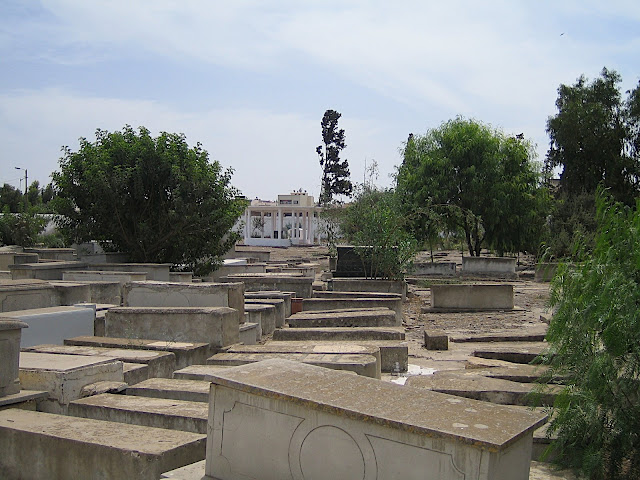
Jewish cemetery in Settat, Morocco (2008)
Jo Amar was born in Settat, Morocco in 1930. By the late 1940s he was recording music in Hebrew and Arabic for Philips. On his Arabic 78s he was known as Jo Amar El Maghribi (Jo Amar the Moroccan) while on his Hebrew 78s he was simply Jo Amar. In 1956 he moved to Israel where he immediately started recording for the Azoulay family – first on 78 on the R. Zaki label and eventually moving to 33 and 45 on Zakiphon.
"Two weeks after I recorded my first song in Israel," recalled Amar in a 2008 interview, "it reached even the most impenetrable Ashkenazi ears." This is one of my all time favorite quotes. You wouldn't expect it from Jo Amar but there he goes again and surprises. By the time Jo Amar arrived in Israel he was a well known entity in the North African community. The Azoulays helped to put him on the musical map in Israel, when no other record label would. The brothers Azoulay apparently sang backup on Shir Hashikor when it was first recorded in Jaffa. Jo Amar would go onto to record for the major Israeli labels as well, on his own Kol Amar label, and on various labels around the world.
Jo Amar El Maghribi. Goulouli fin. Tam Tam. 1960s (Marseilles)
This track is pure Jo Amar. It was recorded in the 1960s for the Tam Tam label out of Marseilles at a time when a number of North African labels were operating there. Goulouli fin is difficult to capture in meaning and in style. It is chaabi-esque as attested to by Tim at Moroccan Tape Stash but it feels like other things are pulling at it. Goulouli fin is Moroccan Arabic for,"Oh tell me where..." There is a sense of longing to the song and it seems to have been paid particular attention to by a number of North African Jewish artists. Below is the cover of a Lili Boniche EP on Dounia where he is performing the same song.
Here is a version by my favorite Cheikh Mwijo off of one of his 1980s cassettes. He recorded the song earlier in his career as well.
By 1970 Jo Amar moved to New York – a combination of push and pull factors including the draw of a better career. He eventually became a Cantor and performed in synagogues spanning the Jewish globe. By the late 1980s / early 1990s Amar returned to Israel and throughout the remainder of his life he would finally collect the honors he so deserved. Jo Amar El Maghribi, arguably Settat's most famous singer, died in Woodmere, New York in 2009 at the age of 79.
I had a great session at the JCC last night. Thank you to everyone for coming out. The next session is next Thursday, February 2nd. There was a request for the set list so I have included below. Also, I will be posting a piece on Jo Amar very soon so stay tuned.
Messaoud Habib (Tunisia)
Taksim Ochak
Columbia – Late 1920s?
I'm heading out of town for the holidays but didn't want to leave everyone hanging. I just digitized the B side of the Blond Blond EP I posted for Hanukkah. This is Blond Blond performing Samy Elmaghribi's scandalous classic - Kouftanek Mahloul (your robe is open in Maghrebi Arabic). In this song, the singer flirts with a woman (Ya lalla - as you will hear throughout) who clearly belongs to someone else. This song has mythic origins and according to this article in Ha'aretz was rumored to be a response by Samy Elmaghribi to accusations that he was having an affair with a member of Morocco's royal family. He vehemently denied this and said that in fact almost the opposite was true - it was he who was being pursued! Whatever the truth is, this was his comeback and it packs a punch. Many a North African musician has performed this song but there is something about Blond Blond's delivery that just makes you want to dance. Go for it.
I know it looks misspelled but El Bonco – Hannouka is one of the greatest Hanukkah songs that you’ve never heard – courtesy, of course, of the master Algerian Jewish singer Blond
Blond. Albert Rouimi, who was given the moniker Blond Blond due to his Albinism, was born in 1919 in Oran, Algeria. From a young age he frequented the cafes that featured legendary Orani musicians like Saoud L’Oranais, Maurice El
Medioni’s father, and Reinette L’Oranaise. His influences ran across both sides of the Mediterranean, he was deeply affected by the music of Charles Trenet and Maurice Chevalier for example, and he found himself going back and forth
between France and Algeria for much of his career. In 1937, he left for Paris
only to return to Oran two years later. It’s unclear how the rise of Vichy France played into
this but needless to say Blond Blond left Paris in 1939 and returned only after end of World
War II.
Back in Oran, he became known as l’Ambianceur for his unique
style of singing and his staccato-like spoken word that interspersed his music.
While Blond Blond could make an audience laugh there was also no doubt that he
was truly a master musician with significant technical knowledge. He was fluent
in the Andalusian repertoire, nailed it in French, commanded chaabi (especially
the musical styling of Lili L’abassi) and pioneered the Francarabe style, a
mixture of French chansons and Arabic chaabi.
Blond Blond. Kouftanek Mahloul et El Bonco Hannouka. Dounia. #1278. 1970s
He released dozens of records throughout his career,
including many on 78 rpm, and recorded for everyone from Pathe to Samyphone to
Dounia. He not only performed from his own work and with his own orchestra but
also collaborated with some of the finest musicians of his day like Reinette
L’Oranaise, Samy Elmaghribi and Line Monty.
Thanks to Phocéephone for this great digitization of Blond
Blond’s El Bonco – Hannouka below. Looks like the original Phocéephone link is dead but luckily I found a mislabeled Youtube video of the same tune. Notice that Blond
Blond quickly switches languages at the beginning of the track and will do so
throughout including when he sings about Hanukkah. Listen carefully at the beginning
when he sings, “le mazal c’est la chance.” Mazal is Hebrew for luck.
Ignore the "Ghir Ajini Ajini" - this is indeed El Bonco-Hannouka
Blond Blond was one of the few Jewish Algerian musicians
that performed in Algeria post-independence and gave two memorable performances
at the Koutoubia music hall in Algiers in 1970 and 1974. Blond Blond, l’Ambianceur,
died in 1999 at the age of 80.
Happy Hanukkah to everyone and please make sure to spread
this around.